What Makes a Security Camera AI-Powered, and Why the Intelligence Lives in the Software, Not the Hardware
There are three types of organizations across Saudi Arabia and the Gulf region: Organizations that rely on an AI security camera for perimeter monitoring (smart organizations) Organizations that have chosen server-based video analytics platforms (smart organizations with clear forward vision) Organizations that operate on traditional surveillance systems In recent years (particularly from 2020 onward), the

| What is an AI security camera?An AI security camera is any camera connected to an Artificial Intelligence (AI) analytics platform that processes its feed in real time. The camera captures and streams video. The AI layer, running on server infrastructure, extracts structured intelligence from that feed: behavioral detections, identity matches, vehicle profiles, and anomaly alerts. Consequently, any Open Network Video Interface Forum (ONVIF) compliant camera meeting minimum resolution requirements becomes an AI security camera when connected to the right platform, without hardware replacement. |
The security camera market has produced a generation of products marketed as AI cameras: cameras with embedded object detection, onboard motion classifiers, and integrated facial recognition chips. The marketing premise is that the intelligence is in the camera.
That premise involves real architectural trade-offs. Intelligence embedded in camera hardware is bounded by what the onboard chip can process, which limits the size and complexity of the models it can run compared to cloud-based systems, though modern edge chips are increasingly capable of running sophisticated detection models, not just simple motion triggers. Updating detection capabilities is possible through firmware and model updates, but is ultimately capped by the hardware's processing ceiling; a meaningfully larger or more complex model may still require new hardware. And while individual cameras often process their own feeds independently, cross-camera identity and behavioral correlation isn't inherently impossible, it depends on whether the system is designed to share metadata across a network or hub, which many edge-AI systems now do.
AvidBeam's platform takes the opposite approach. The cameras are standard. The intelligence is in the server-based analytics layer that processes every camera's feed centrally. Consequently, any camera already installed becomes an AI security camera the moment it connects to the platform, with no hardware change at the camera itself.
The Architecture That Makes a Camera an AI Security Camera
The distinction between a camera marketed as AI and a camera that functions as AI comes down to where the processing happens and what models run on that processing.
Edge Processing vs. Server-Based Processing
Edge-based AI cameras embed processing in the camera housing. The detection models that run are limited by what the embedded hardware can execute. As covered in AvidBeam's guide to evaluating AI video analytics companies, the accuracy ceiling for edge-based AI is a function of hardware, not model sophistication. As models improve, edge hardware becomes a constraint rather than an enabler.
Server-based AI security cameras separate the analysis from the camera entirely. The camera captures and streams. The AI platform processes centrally. Consequently, the detection model complexity scales with server infrastructure rather than with camera hardware. Furthermore, new detection capabilities deploy as software updates across every connected camera simultaneously rather than requiring per-device hardware changes.
What the AI Layer Actually Detects
The AI analytics layer behind a server-based security camera can run larger and more computationally intensive detection models than most embedded edge cameras currently support, due to differences in processing power, memory, and thermal budget. These can include advanced behavioral baseline models for distinguishing genuine threats from environmental noise, deep learning facial recognition designed to maintain high accuracy under masks or non-frontal angles, and Vision Language Models (VLMs) that convert video into natural language descriptions for post-incident investigation, capabilities that are typically harder to run in real time on current-generation edge hardware, Because processing happens on server infrastructure rather than fixed onboard hardware, the system can scale compute capacity as the number of connected cameras grows, rather than being limited to what a single embedded chip can handle. This allows detection models to run across many camera feeds without being constrained by any one camera's hardware, though, like any system, actual throughput depends on the server resources provisioned relative to camera count and the number of models running simultaneously.
| To find out how AvidBeam's AI security platform applies to your existing cameras, send an email to info@avidbeam.com and the technical team will follow up. |
What AvidBeam's AI Security Cameras Detect
AvidBeam's platform activates five primary AI security capabilities on every connected camera. Each capability runs through a dedicated product suite. All suites share the same server-based processing architecture and the same management interface.
Security & Safety Detection
AvidGuard applies behavioral AI models to every connected camera feed. The platform learns what normal activity looks like per monitored zone across different operational periods. When behavior deviates from that baseline, an alert fires. Detection events include intrusion across predefined boundaries, loitering beyond zone-specific thresholds, tailgating at access points, crowd density anomalies, left object detection, scene change, fire and smoke, and Personal Protective Equipment (PPE) compliance violations.
N+1 redundancy maintains continuous behavioral detection despite individual hardware failures. Consequently, AI security camera coverage has no gaps during maintenance periods or hardware replacement cycles.
Intelligent Facial Recognition
AvidFace applies facial recognition AI to every face detected in a connected camera frame. Recognition accuracy stays above 90%, with capability of facial detections under masks, glasses, hats, and non-frontal angles. Deny lists, allow lists, and Very Important Person (VIP) lists run in parallel at every connected camera simultaneously. Zone movement tracking surfaces unauthorized zone access automatically. Reverse image search compresses post-incident identity investigation from hours to minutes.
All-in-one Vehicle Detections & Analytics
AvidAuto applies vehicle recognition AI to cameras covering access points, roads, and parking areas. License Plate Recognition (LPR) reaches 98%+ for Arabic plates and 92%+ for English. Every detection produces a full vehicle profile including type, make, model, and color alongside the plate read. Watchlist matching runs at every camera the vehicle passes. AB - ITS extends violation detection to road segments. AB - Smart Parking extends occupancy monitoring to parking structures.
Video/Image Transformation into Natural Language
AvidGenAI is a real-time Gen-AI video analytics platform that uses Visual Language Models to turn surveillance footage into natural language, enabling conversational search, instant anomaly detection, and actionable insights across any sector. Its VLM-driven engine converts any camera feed into queryable data. Urban Safety delivers real-time hazard alerts for infrastructure and public spaces; Structural Compliance flags building anomalies and risks across asset lifecycles; and Retail Insights analyzes customer behavior, generating natural-language KPIs to optimize store operations and marketing performance.
Real-time Retail Analytics Operator
AvidSight™ is AvidBeam's dedicated video analytics suite for retail and banking, built to transform customer experience and operational efficiency. Powered by AI, it helps businesses understand visitor behavior, optimize layouts, and improve service delivery in real time. Beyond customer engagement, AvidSight™ strengthens compliance and security in financial environments, monitoring ATM usage, tracking employee presence, and overseeing vault access, delivering actionable intelligence that empowers organizations to operate smarter, safer, and more transparently.
What AI Security Cameras Detect That Standard Cameras Cannot
The table below maps every AI security detection capability AvidBeam's platform delivers on connected cameras, the suite that powers each one, and what it produces operationally.
| AI Security Capability | AvidBeam Suite | What It Delivers |
|---|---|---|
| Behavioral anomaly detection | AvidGuard | Intrusion, loitering, tailgating, crowd density, fire and smoke, PPE compliance; learned baseline per zone |
| Identity verification | AvidFace | Facial recognition at 90%+; deny, allow, and VIP lists; zone movement tracking; reverse image search |
| License Plate Recognition (LPR) | AvidAuto | 98%+ Arabic / 92%+ English; vehicle classification; watchlist matching; forensic search |
| Traffic violation detection | AB - ITS | Seven violation types continuously; density analytics; congestion forecasting |
| Parking intelligence | AB - Smart Parking | Real-time occupancy; double-parking; blocking and overtime alerts |
| Heatmap and spatial analytics | AvidSight | Movement density, dwell time, pathway analysis, demographic distribution |
| Natural language investigation | AvidGenAI | Plain language queries across full network; post-incident results in minutes |
| Scene change detection | AvidGuard | Camera tampering and zone reconfiguration detected automatically |
| Left object detection | AvidGuard | Unattended items near access points flagged on zone-specific duration threshold |
| Fire and smoke detection | AvidGuard | Visual detection of fire and smoke patterns before sensor-based triggers |
Standard Security Camera vs. AvidBeam AI Security Camera - Comparison
The table below sets out where AvidBeam's AI security camera platform diverges from standard security cameras at the detection depth, accuracy, scalability, and investigation level. As covered in AvidBeam's analysis of what modern building security systems require, the gap between recording and detecting is the gap between documentation and prevention.
| Dimension | Standard Security Camera | AvidBeam AI Security Camera |
|---|---|---|
| Detection capability | Motion only; fires on anything that moves | Behavioral baselines, identity, vehicle classification, violation detection, spatial analytics |
| False positive rate | High; weather, wildlife, and shadows trigger alerts | Low; AI baselines filter environmental noise from genuine security events |
| Identity verification | Not available from camera hardware alone | Facial recognition at 90%+ with real-time watchlist matching |
| Vehicle intelligence | Not available without separate LPR hardware | LPR, classification, and watchlist matching from the same camera |
| Investigation | Manual footage review; hours per case | Natural language query across full network; results in minutes |
| Night performance | Degraded; same sensitivity regardless of context | Behavioral baselines adjust per time window; after-hours thresholds applied automatically |
| Scalability | New hardware per additional coverage point | Software extension to cameras already covering new zones |
| Updates | Firmware change per device required | Software update across full network simultaneously |
In short, a standard security camera records what happens. An AvidBeam AI security camera detects what should not be happening, alerts before incidents escalate, verifies who is present, tracks vehicles, and answers investigation queries in plain language, from the cameras already installed.
What Makes a Camera Meet AI Security Camera Requirements
Since the AI processing happens server-side, the camera's role is to produce a clear feed that the analytics layer can process reliably. The minimum camera requirements for AvidBeam's AI security platform:
- Open Network Video Interface Forum (ONVIF) compliant connection via standard network protocols
- Resolution: 2MP minimum up to 4K
- Lens focal length: 3mm to 25mm
- Mounting angle: pitch -15° to +15°; yaw -15° to +15°; roll -180° to +180°
The server infrastructure baseline per camera processed:
- 2GB RAM minimum; one virtual core at 2.4 GHz minimum
- Multiple Graphics Processing Unit (GPU) configurations supported for higher-density deployments
Video Management System (VMS) integration covers Milestone, NetworkOptix, and Genetec platforms. Deployment options include on-premise, private cloud, public cloud, and hybrid. Consequently, most cameras already installed across a facility meet the requirements to become AI security cameras through software connection to AvidBeam's platform.
FAQ
What is an AI security camera?
Any camera connected to an AI analytics platform that processes its feed in real time, extracting behavioral detections, identity matches, vehicle profiles, and anomaly alerts without hardware changes at the camera itself.
Do I need to replace my existing cameras to get AI security?
No. AvidBeam connects to any existing ONVIF compliant camera meeting minimum resolution and angle requirements; the AI processing happens on server infrastructure, not in the camera.
What is the difference between an AI security camera and a standard security camera?
A standard camera records footage; an AI security camera extracts real-time detections, behavioral alerts, identity matches, and vehicle intelligence from the same feed through a server-based analytics platform.
What detection types does an AI security camera support?
Behavioral intrusion detection, facial recognition, license plate recognition, vehicle classification, traffic violation enforcement, parking intelligence, heatmap analytics, and natural language investigation, running simultaneously on each connected camera.
Can multiple AI detection types run on the same camera?
Yes. Behavioral detection, identity verification, vehicle intelligence, and investigation capabilities all run through the same server-based platform on the same camera feeds simultaneously.
How do AI security cameras perform at night?
Behavioral baselines adjust per time window; after-hours detection applies lower thresholds so minimal unusual presence triggers alerts that identical daytime presence would not.
How does adding new AI security cameras work?
Adding coverage means connecting new cameras to the existing server-based platform through software configuration; no new hardware at individual coverage points is required.
| Want to see AI security cameras in action?Request a live demo of AvidBeam's platform and see how AI security applies to your facility's existing cameras. Send an email to info@avidbeam.com to schedule a session with the technical team. |
 Article
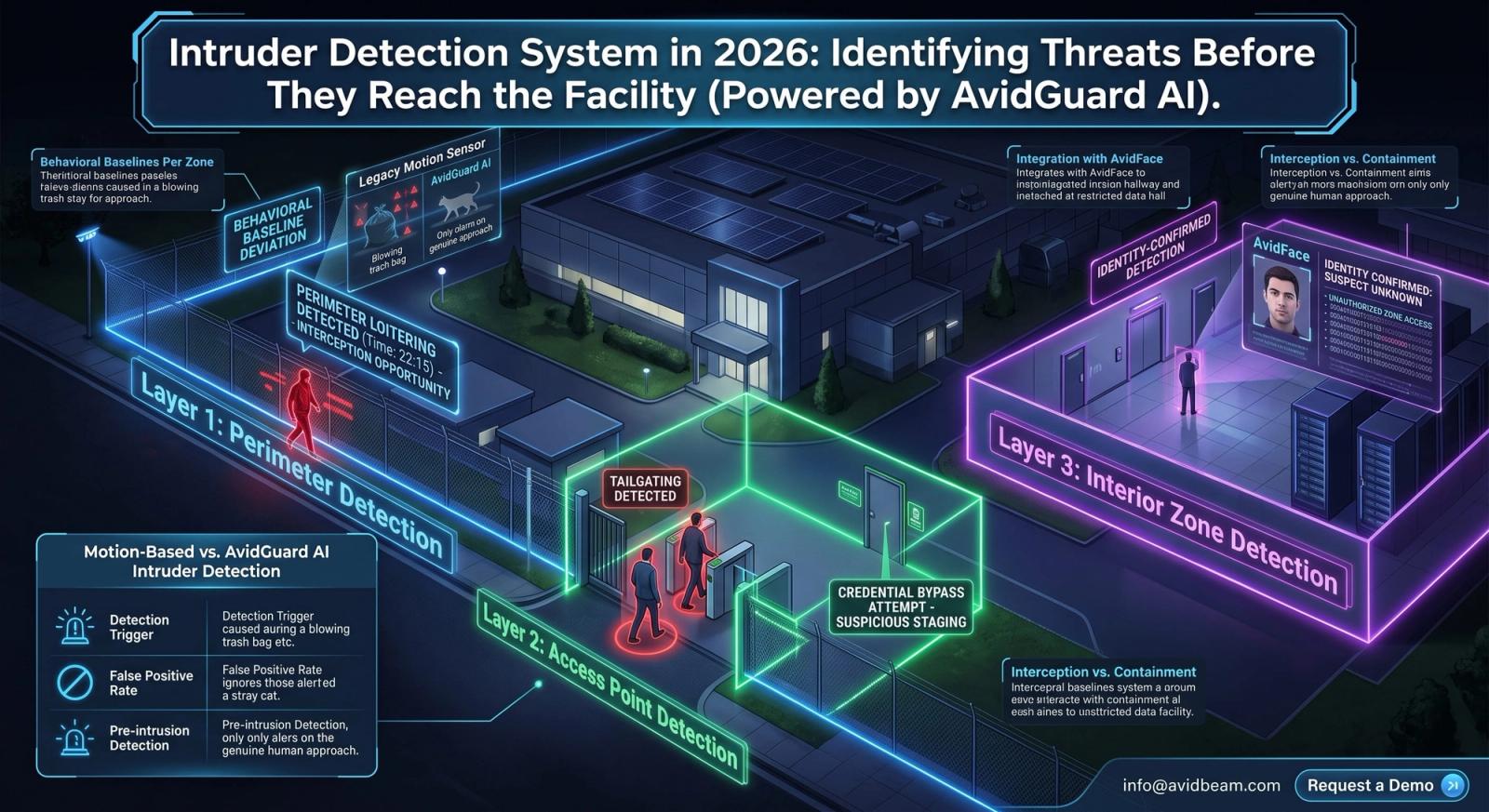
Intruder Detection System in 2026: How AvidBeam's AvidGuard Identifies Threats Before They Reach the Facility
A motion sensor tells you that something moved. An Artificial Intelligence (AI) intruder detection system tells you that something happened that should not have, given what normally happens in that zone at that time.
 Article
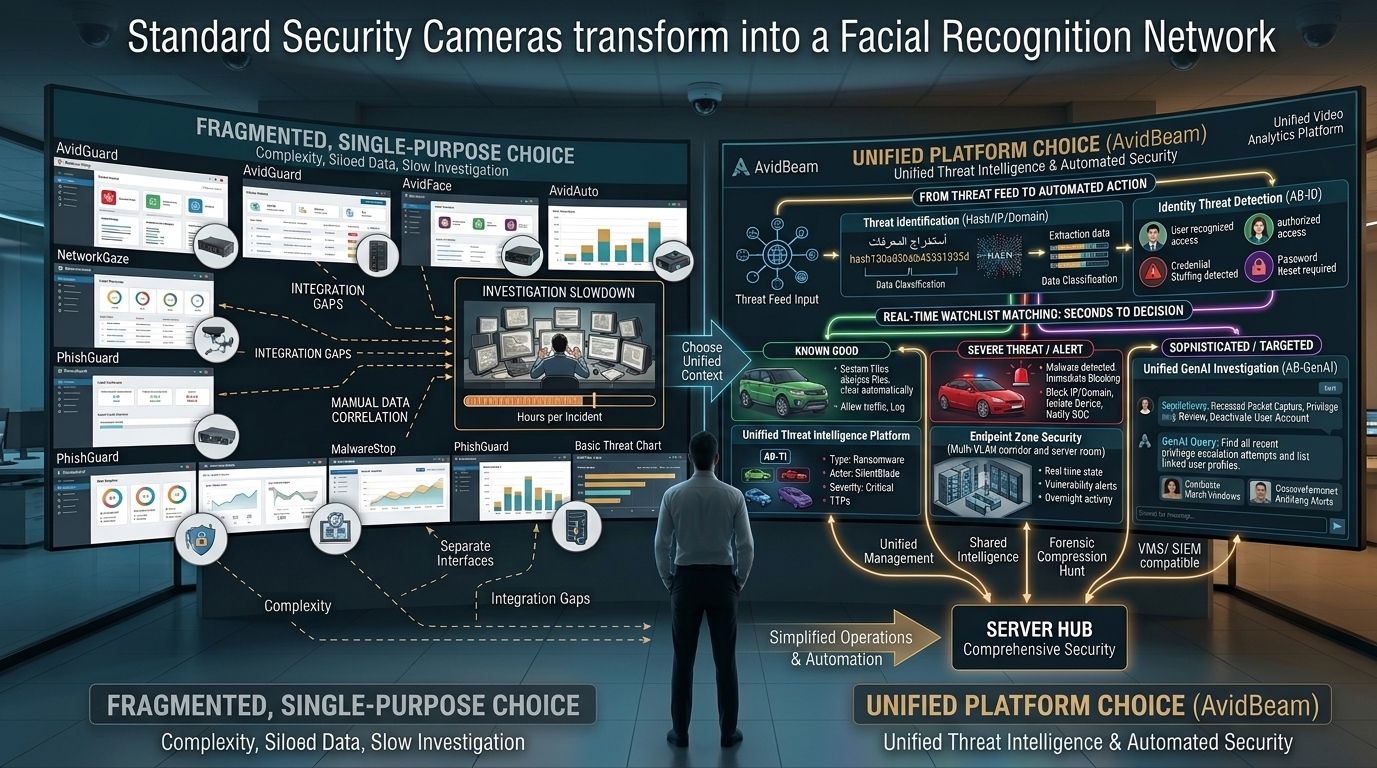
What Makes a Camera a Facial Recognition Camera, and Why the Answer Is Not About the Hardware
Facial recognition cameras are any cameras connected to a facial recognition analytics platform that processes their feeds in real time.
 Article
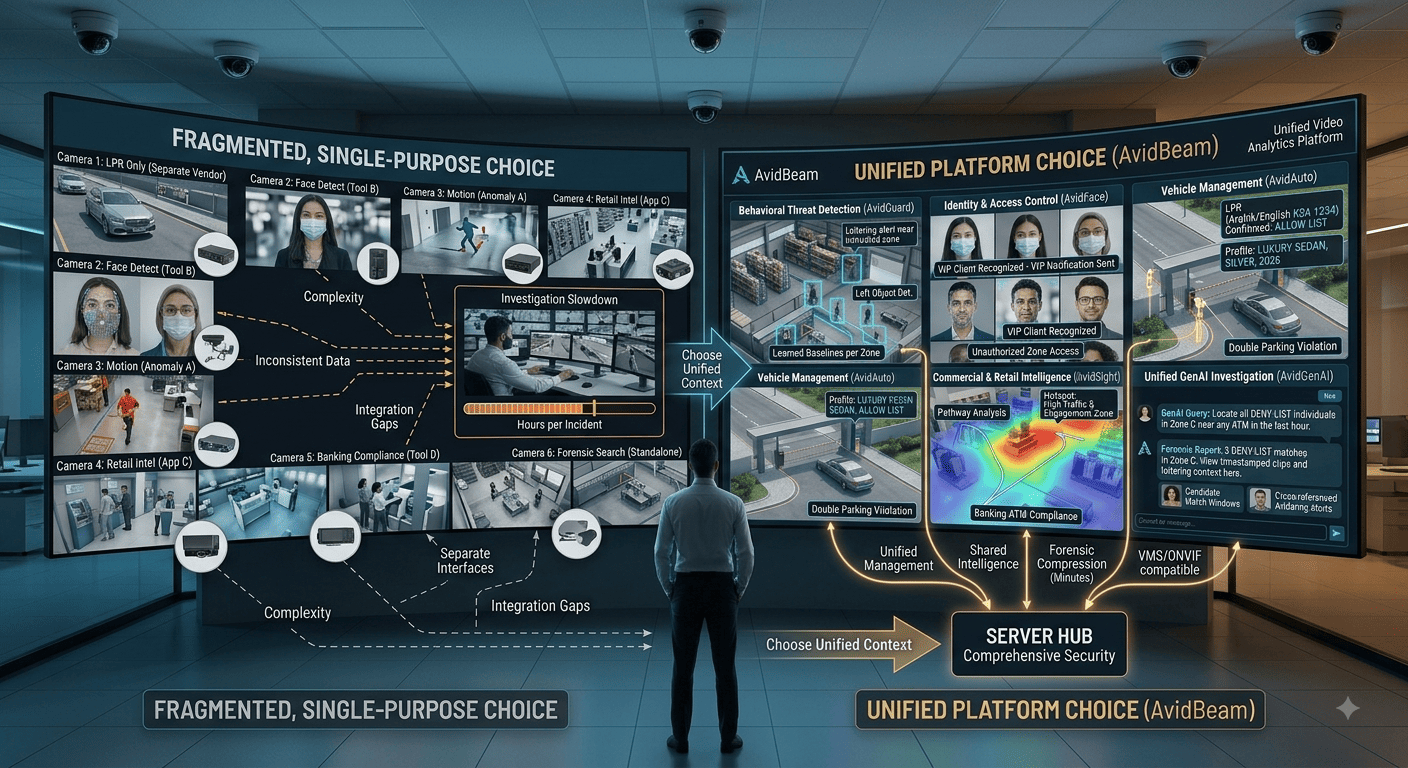
AI Video Analytics Software Is Not an Add-On. It Is What Turns a Camera Network Into a Security and Intelligence Platform.
The distinction between AI video analytics software and hardware-embedded analytics is architectural, not cosmetic.
Experience AI Video Analytics
on your existing cameras.
Start with a pilot deployment and scale seamlessly as your operational requirements evolve.