AI Video Analytics Software Is Not an Add-On. It Is What Turns a Camera Network Into a Security and Intelligence Platform.
The distinction between AI video analytics software and hardware-embedded analytics is architectural, not cosmetic.
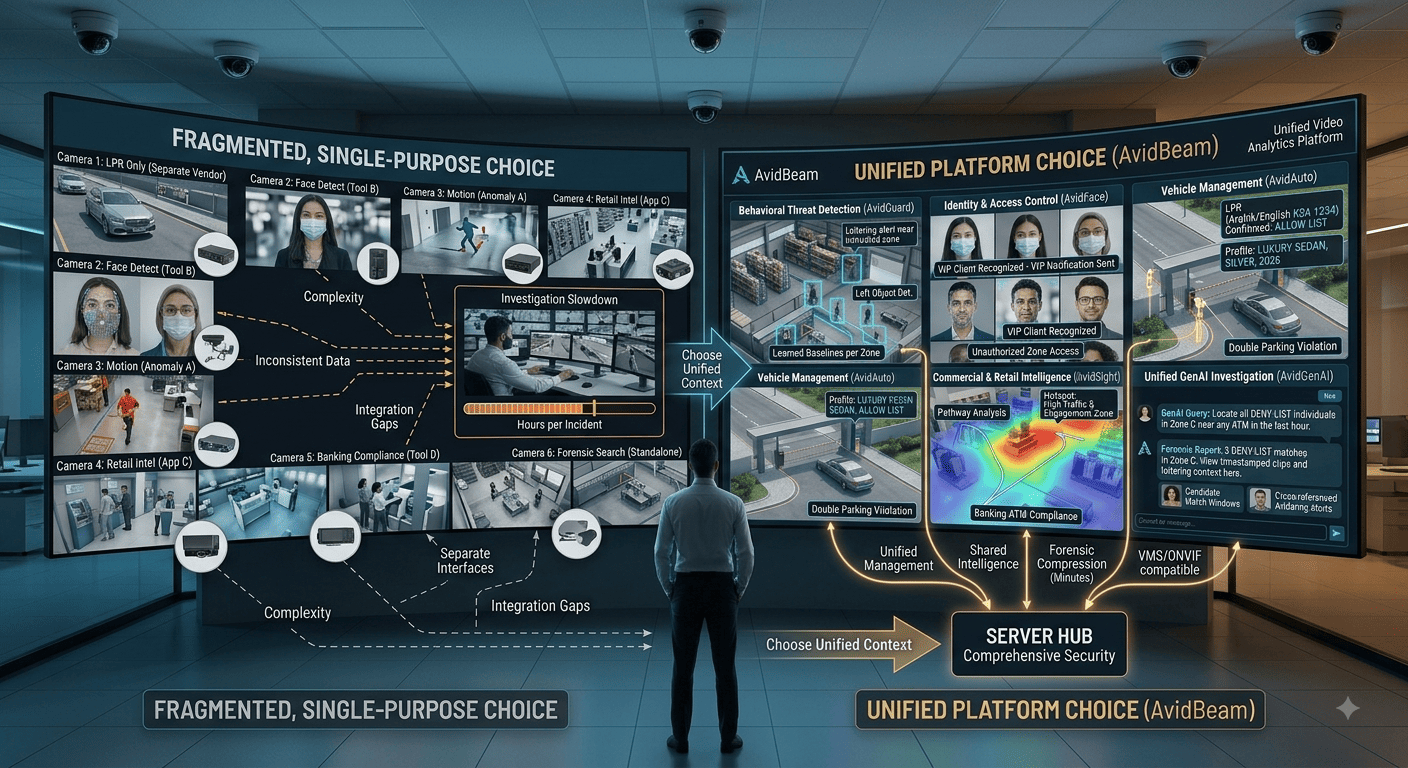
| What is AI video analytics software?AI video analytics software is a platform that applies Artificial Intelligence (AI) deep learning models to camera feeds, extracting real-time detections, behavioral intelligence, identity verification, vehicle data, and commercial analytics without replacing existing camera hardware. It runs on server infrastructure, connects to Open Network Video Interface Forum (ONVIF) compliant cameras already installed, and scales through software configuration rather than hardware installation at individual coverage points. |
The distinction between AI video analytics software and hardware-embedded analytics is architectural, not cosmetic. Hardware-embedded systems put the analysis at the camera: a dedicated unit at each gate, each intersection, each access point. The analysis capability is constrained by what that unit can process. Updates require hardware changes. Scaling requires new units.
AI video analytics software separates the analysis from the camera entirely. The software runs on centralized server infrastructure. The camera captures and streams. The software analyzes. Consequently, model complexity scales independently of camera hardware, capabilities update across the full network through software, and adding new coverage zones means extending the software to cameras already installed rather than purchasing hardware for each new point.
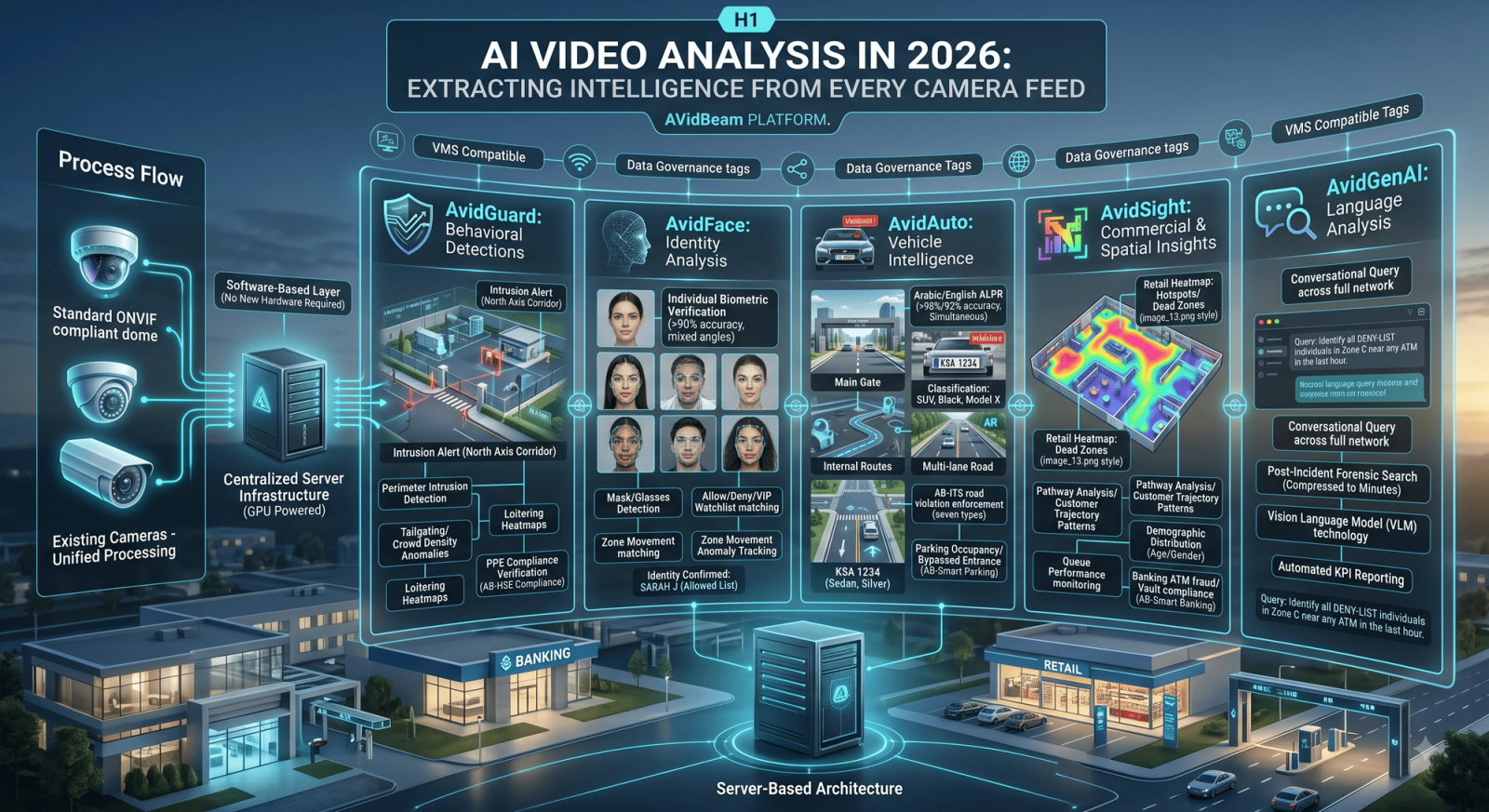
AvidBeam's platform is server-based AI video analytics software covering five capability domains: behavioral threat detection through AvidGuard, identity verification through AvidFace, vehicle intelligence through AvidAuto, commercial analytics through AvidSight, and natural language investigation through AvidGenAI. All five run on the cameras already installed, through one management interface.
Why Software Architecture Determines Analytics Performance
The architecture of AI video analytics software determines three things that feature lists do not reveal: how accurate the analytics are under real conditions, how the platform scales, and what it costs to maintain as requirements change.
Accuracy Independence From Camera Hardware
Edge-based analytics systems embed processing in camera hardware. The recognition or detection model that runs is constrained by what the embedded hardware can execute. As the AI models improve, the hardware at individual cameras becomes the ceiling. As covered in AvidBeam's analysis of what separates modern video surveillance platforms, server-based AI video analytics software removes that ceiling entirely.
AvidBeam's software processes all analysis centrally. The same models run across every connected camera regardless of individual camera age or hardware capacity. Consequently, a camera installed five years ago delivers the same analytical depth as one installed last week, because the analysis happens on the server, not at the camera.
Software-Defined Scalability
Hardware-based analytics scales by adding hardware: a new access point requires a new detection unit, a new gate requires a new license plate reader, a new floor requires a new people-counting sensor. Each expansion is a procurement and installation project.
AI video analytics software scales by configuration: a new access point means pointing the software at cameras already covering that point. No procurement lead time. No installation project. No hardware cost per new zone. Furthermore, capability updates deploy across the full network simultaneously through software rather than requiring per-device firmware changes or hardware replacement.
| To find out how AvidBeam's AI video analytics software applies to your existing camera infrastructure, send an email to info@avidbeam.com and the technical team will follow up. |
What AvidBeam's AI Video Analytics Software Covers
AI video analytics software that covers a single capability domain addresses one operational problem. A platform that covers five domains through one software deployment, one management interface, and one investigation layer addresses the full operational picture. As covered in AvidBeam's guide to what to ask AI video analytics companies before deployment, the integration between capability domains is where the operational return compounds most significantly.
Behavioral Detection Software
AvidGuard is AvidBeam's behavioral detection software module. It applies deep learning behavioral models to perimeter zones, access corridors, and operational areas. The software learns a behavioral baseline per monitored zone and generates alerts for genuine deviations: loitering, intrusion, tailgating, crowd density anomalies, left object detection, fire and smoke, and Personal Protective Equipment (PPE) compliance violations. N+1 redundancy maintains continuous detection despite individual hardware failures.
Identity Verification Software
AvidFace is AvidBeam's identity verification software module. It applies facial recognition models to every face detected in a connected camera frame, matching against enrolled identity databases in fractions of a millisecond. Accuracy stays above 90% under masks, glasses, and non-frontal angles. Deny lists, allow lists, and Very Important Person (VIP) lists run simultaneously at every connected access point. Zone movement tracking surfaces unauthorized zone access automatically against each individual's authorization profile.
Vehicle Intelligence Software
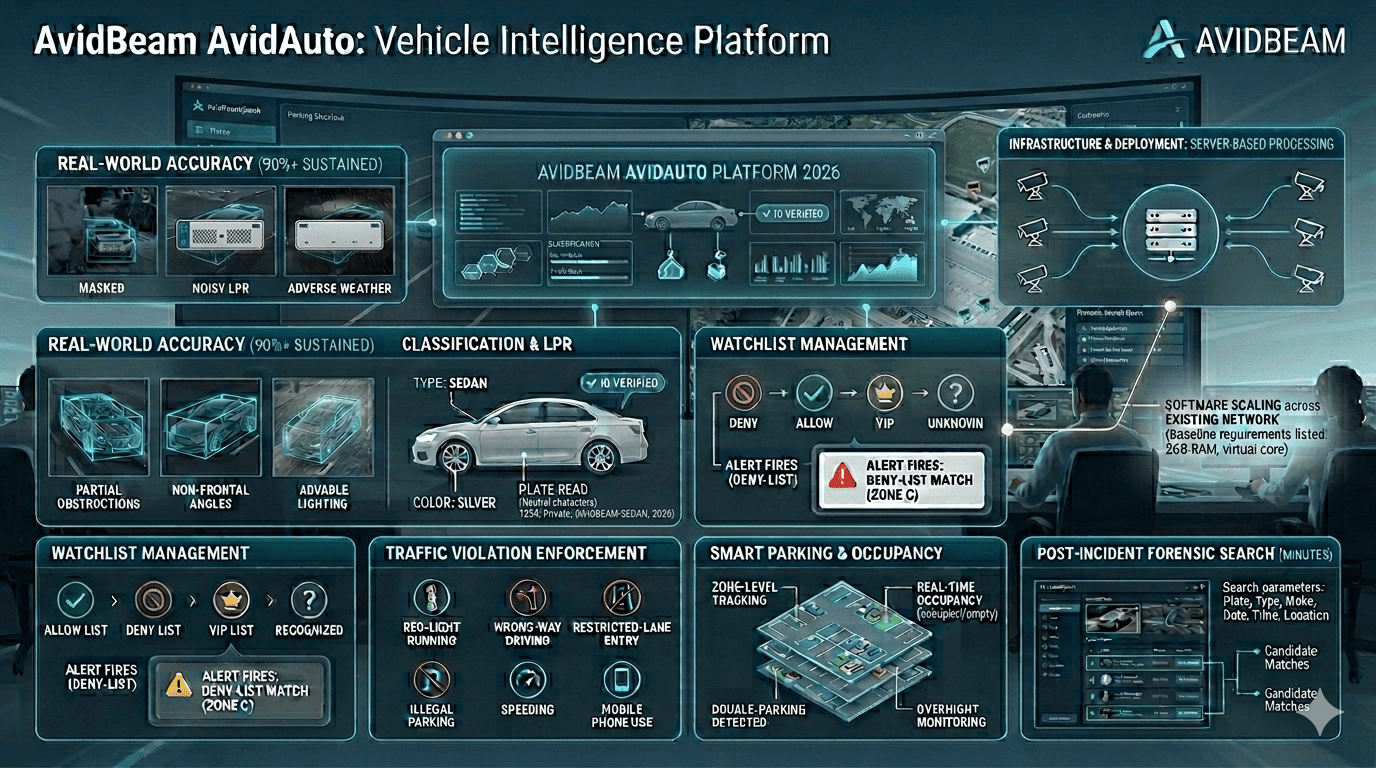
AvidAuto is AvidBeam's vehicle intelligence software module. It applies License Plate Recognition (LPR), vehicle classification, and violation detection models to every monitored camera feed. LPR accuracy reaches 98%+ for Arabic plates and 92%+ for English. AB - ITS enforces seven traffic violation types continuously. AB - Smart Parking manages real-time parking occupancy and compliance across monitored structures.
Commercial Analytics Software
AvidSight is AvidBeam's commercial analytics software module. It applies spatial analysis, demographic analysis, and behavioral models to retail and banking environments. The AB - Retail module produces heatmaps, pathway analysis, dwell time metrics, demographic distribution, and queue performance from existing cameras. The AB - Smart Banking module covers ATM violation detection, employee absence monitoring, unattended cash detection, and vault access enforcement.
Investigation and Reporting Software
AvidGenAI is AvidBeam's investigation and reporting software module. It applies a Vision Language Model (VLM) to the full platform, converting camera feeds and detection outputs into natural language. Operators query the full network in plain language and receive timestamped results with camera sources and detection context. Post-incident investigation compresses from hours to minutes. Automated Key Performance Indicator (KPI) reports generate from video observations without manual data aggregation.
Full Software Capability and Deployment Breakdown
The table below maps every capability AvidBeam's AI video analytics software delivers across its five modules, alongside the deployment and integration specifications that apply to each.
| Software Capability | AvidBeam Suite | What It Delivers |
|---|---|---|
| Behavioral detection | AvidGuard | Loitering, intrusion, tailgating, crowd density, fire and smoke, PPE compliance; learned baseline per zone |
| Identity verification | AvidFace | 90%+ accuracy; deny, allow, and VIP watchlists; zone movement tracking; forensic image search |
| Vehicle intelligence | AvidAuto | LPR at 98%+ (Arabic) / 92%+ (English); AB - ITS violation detection; AB - Smart Parking occupancy |
| Commercial analytics | AvidSight | Heatmaps, dwell time, demographic distribution, queue performance; AB - Smart Banking compliance |
| Natural language investigation | AvidGenAI | Plain language queries; post-incident investigation in minutes; automated KPI reports |
| VMS integration | All suites | Milestone, NetworkOptix, and Genetec platforms supported |
| Hardware compatibility | All suites | Any ONVIF compliant camera meeting minimum resolution and compute specifications |
| Deployment flexibility | All suites | On-premise, private cloud, public cloud, and hybrid configurations |
| Update mechanism | All suites | Software updates deploy across full camera network simultaneously without per-device changes |
| Scalability | All suites | New zones added through software configuration; no hardware installation per coverage point |
Hardware-Embedded Analytics vs. AvidBeam AI Video Analytics Software
The table below sets out where AvidBeam's server-based software approach diverges from hardware-embedded analytics at the deployment, scalability, accuracy, and cost level.
| Dimension | Hardware-Embedded Analytics | AvidBeam AI Video Analytics Software |
|---|---|---|
| Deployment approach | Hardware units installed at each access point | Software layer connects to cameras already installed; no hardware per point |
| Capability updates | Hardware replacement required for new models | Software update deploys across full network simultaneously |
| Scalability | New hardware per additional coverage zone | Software configuration extends to cameras already covering new zones |
| Accuracy ceiling | Constrained by embedded hardware at each unit | Server-based processing scales independently of individual camera hardware |
| Multi-site management | Separate configuration per location | Unified interface; software propagates updates to all sites instantly |
| Detection scope | Single capability per unit in most cases | Five capability domains running simultaneously through one software platform |
| Investigation | Manual footage review | Natural language query layer across full network in minutes |
| Total cost | High hardware investment at scale | Software license on existing infrastructure; lower cost per additional zone |
In short, hardware-embedded analytics installs capability at individual points. AvidBeam's AI video analytics software installs capability across the full camera network through one deployment, scales through configuration rather than procurement, and updates through software rather than hardware replacement.
Integration and Deployment
AvidBeam's AI video analytics software integrates with existing Video Management System (VMS) platforms and connects to any ONVIF compliant camera via standard network protocols. No camera replacement required.
VMS integration covers Milestone, NetworkOptix, and Genetec. All five software modules feed detection outputs directly into the operator's existing VMS interface.
The infrastructure baseline per camera the software processes:
- 2GB RAM minimum; one virtual core at 2.4 GHz minimum
- Multiple Graphics Processing Unit (GPU) configurations supported for higher-density deployments
- Camera resolution: 2MP up to 4K; lens focal length 3mm to 25mm
Deployment options include on-premise, private cloud, public cloud, and hybrid configurations. On-premise deployment keeps all detection data and biometric records local. Cloud deployment removes the need for local server infrastructure at each site. Hybrid configurations split processing based on data classification requirements.
FAQ
What is AI video analytics software?
A server-based platform that applies AI deep learning models to camera feeds, extracting behavioral detections, identity matches, vehicle data, spatial analytics, and natural language investigation results from existing camera infrastructure without hardware replacement.
How does AI video analytics software differ from hardware-embedded analytics?
Hardware-embedded analytics processes at individual cameras, constraining accuracy and scalability by hardware capacity; server-based software processes centrally, scaling accuracy and capability independently of camera hardware.
Does AI video analytics software require new cameras?
No. AvidBeam's software connects to any existing ONVIF compliant camera; the minimum is 2GB RAM and one virtual core at 2.4 GHz per camera on the processing server.
How does the software scale to new coverage zones?
New zones are added through software configuration pointing the platform at cameras already covering those zones; no hardware installation or procurement is required per new coverage point.
Which VMS platforms does AvidBeam's software integrate with?
Milestone, NetworkOptix, and Genetec; all five software modules feed detection outputs directly into the operator's existing VMS interface.
What deployment models are available?
On-premise, private cloud, public cloud, and hybrid configurations are all available based on data governance and operational requirements.
Can all five software modules run simultaneously on the same cameras?
Yes. Behavioral detection, identity verification, vehicle intelligence, commercial analytics, and investigation all run through the same server-based platform on the same camera feeds.
| Want to see AvidBeam's AI video analytics software in action?Request a live demo and see how the software applies to your facility's existing cameras. Send an email to info@avidbeam.com to schedule a session with the technical team. |
 Article
AI Video Analysis in 2026: How AvidBeam Extracts Intelligence From Every Camera Feed
AI video analysis is the application of Artificial Intelligence (AI) models to video feeds to extract structured intelligence from raw footage.
 Article
Detection Is the Starting Point. What Happens Next Is What Separates Vehicle Detection Systems.
Basic vehicle detection systems count vehicles. Some read plates. Most stop there. However, the operational problems that facility managers, traffic coordinators, and security teams actually face start after the detection event, not before it.
 Article
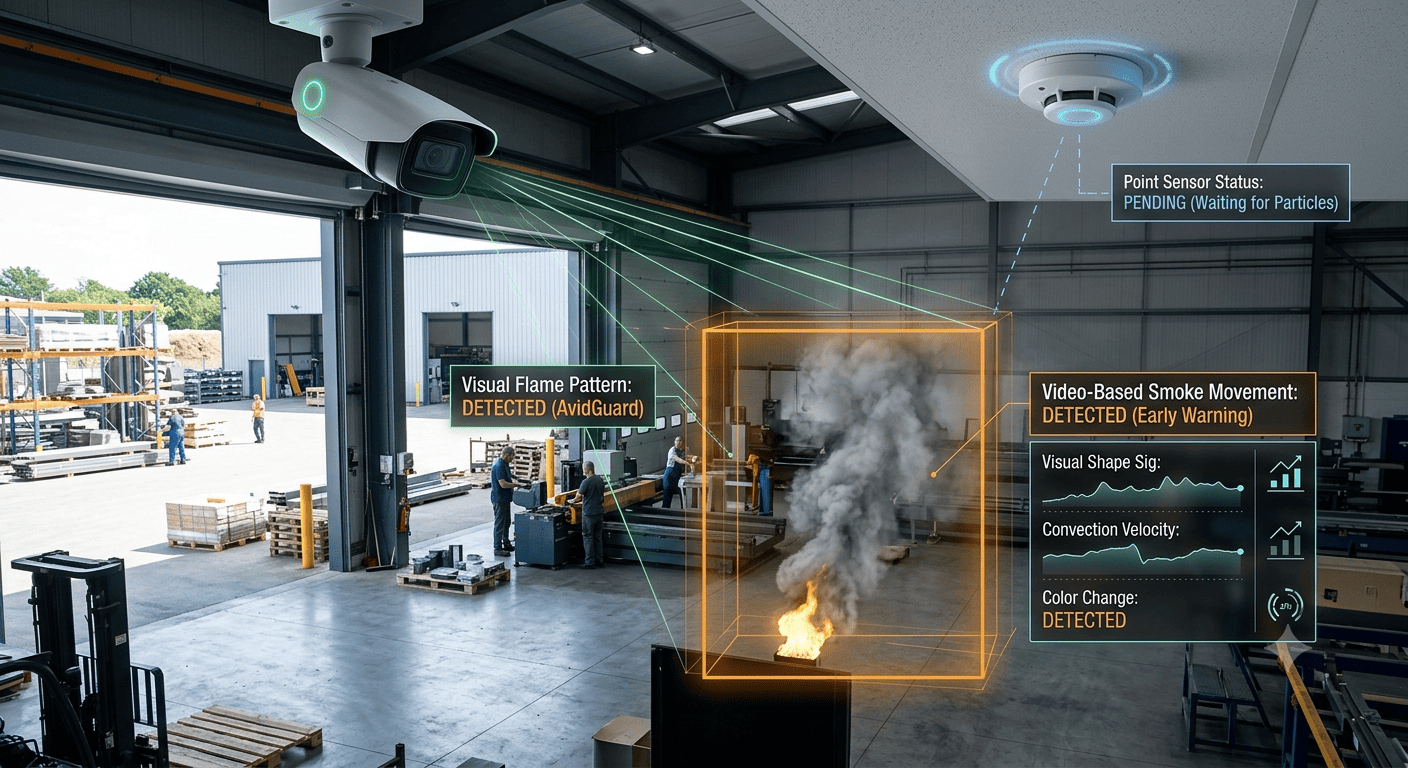
Point Sensors Trigger When Smoke Arrives. Video-Based Smoke Detection Triggers When Fire Begins.
A traditional smoke Detection has one job: to detect smoke particles when they reach the sensor. It performs that job reliably under the conditions it was designed for – indoor spaces, predictable airflow, and smoke concentrations that build gradually enough to reach ceiling height before anyone needs to respond. In most facilities where fire risk
Experience AI Video Analytics
on your existing cameras.
Start with a pilot deployment and scale seamlessly as your operational requirements evolve.