Oil and Gas Video Surveillance: How AI Covers PPE Compliance, Fire Detection and Perimeter Security Simultaneously
Oil and gas video surveillance should go beyond recording. In a petrochemical or refinery environment, cameras should automatically verify Personal Protective Equipment (PPE) compliance per worker per zone
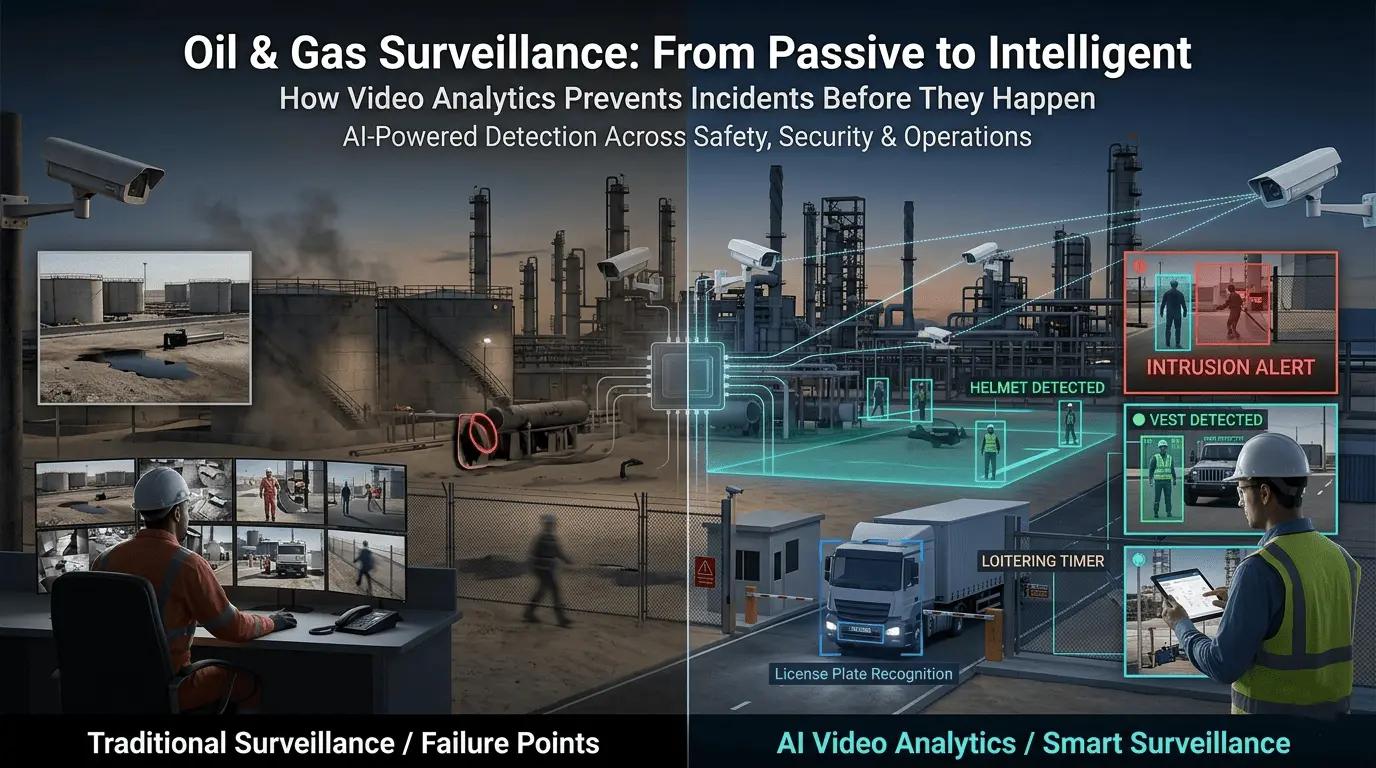
| What should oil and gas video surveillance do?Oil and gas video surveillance should go beyond recording. In a petrochemical or refinery environment, cameras should automatically verify Personal Protective Equipment (PPE) compliance per worker per zone, detect visual fire and smoke patterns before sensor-based systems trigger, identify perimeter intrusions before they reach processing infrastructure, monitor vehicle access at gates, and generate shift-by-shift compliance data without requiring supervisors to be physically present in every hazardous area simultaneously. |
Oil and gas facilities have a surveillance problem that recording alone cannot solve. The scale of a processing plant or tank farm means that a supervisor cannot be physically present in every hazardous zone simultaneously. Night shifts reduce human coverage precisely when the consequences of undetected non-compliance or an unidentified fire signature are highest.
Standard Closed-Circuit Television (CCTV) records what happens in those areas. AI video surveillance understands it. The same cameras that passively capture footage across the facility can actively verify PPE compliance, detect early fire and smoke signatures, flag perimeter intrusions, and control vehicle access, all simultaneously and without a supervisor present in each zone.
AvidBeam's platform is deployed at SABIC petrochemical facilities in Saudi Arabia specifically for this combination of safety and security intelligence. The deployment demonstrates at verified scale what AI video surveillance for oil and gas actually delivers when it is configured for the specific detection requirements of a high-consequence industrial environment.
What Are the Specific Video Surveillance Needs in Oil and Gas?
Oil and gas facilities have detection requirements that differ from commercial buildings or retail environments in three important ways: the consequence of a missed detection is higher, the coverage area is larger, and the environmental conditions are more extreme.
PPE Compliance Cannot Depend on Supervision Alone
Manual PPE (Personal Protective Equipment) compliance monitoring has one consistent limitation: it reflects compliance when someone is watching. Spot checks during day shifts produce results that do not represent behavior across the full facility and the full working day. As covered in AvidBeam's analysis of PPE detection across industrial environments, the gap is most significant during night shifts, shift transitions, and in zones that are physically distant from supervisor stations.
AvidGuard's AvidGuard AB - Health, Safety and Environment (HSE) Compliance module verifies required PPE per worker per zone continuously from existing camera feeds. Every non-compliant worker entering a monitored area generates an immediate alert before they reach the hazard zone. Violation rate data per zone and shift generates automatically without manual inspection logs.
Fire and Smoke Detection Before Sensors Trigger
Thermal and smoke sensor-based fire detection systems trigger when fire or smoke reaches the sensor. Visual fire and smoke patterns in camera feeds appear earlier, often before the physical thresholds that activate sensor systems are reached.
AvidGuard's fire and smoke detection module identifies these visual patterns from existing camera feeds. In an oil and gas environment where a fire near a processing unit or tank farm can escalate rapidly, the additional detection lead time that visual AI provides represents a meaningful improvement in the response window available to safety teams.
Perimeter Security Across Large Outdoor Areas
As covered in AvidBeam's analysis of video analytics for oil and gas surveillance, perimeter intrusion in an oil and gas environment is not only a security concern. An unauthorized individual near a processing unit, a chemical handling area, or a tank farm represents a safety risk to the individual as well as an operational risk to the facility. AvidGuard's behavioral baseline models detect perimeter approach behavior and loitering near restricted boundaries before an intrusion event occurs.
The alert fires during approach behavior, before the individual reaches the perimeter line. Consequently, security teams have an intervention window that post-entry detection systems do not provide.
| Want to know how AvidBeam's oil and gas surveillance configuration applies to your facility? Send an email to info@avidbeam.com for a technical assessment. |
What PPE Items Does AI Video Surveillance Verify in Oil and Gas?
The table below maps every PPE item AvidGuard's AB - HSE Compliance module (Health, Safety & Environment) verifies in oil and gas environments, how detection works, and the zone application for each item.
| PPE Item | How AvidGuard Detects It | Zone Application |
|---|---|---|
| Safety helmets | Shape and position on head per individual in monitored zone | Alert fires before non-compliant worker enters the hazard area |
| Face masks | Presence and correct coverage verified per detected face | Healthcare, chemical, and refinery zone compliance |
| Safety gloves | Glove presence on hands per individual | Chemical handling and electrical zone compliance |
| Safety shoes | Footwear type at zone entry points | Industrial floors and loading area compliance |
| Ear protection | Earmuff or earplug presence in high-noise zones | Compressor, turbine, and heavy machinery areas |
| Safety vests | High-visibility vest presence per individual | Outdoor areas, roads, and loading zones |
| Safety glasses | Protective eyewear per individual | Grinding, cutting, chemical, and welding areas |
| Hairnets | Head covering at controlled zone entry | Chemical processing and food-grade production areas |
Full AI Video Surveillance Capability Breakdown for Oil and Gas
The table below maps every detection capability AvidBeam's platform delivers for oil and gas environments, how each one works, and what it produces for safety and security operations.
| Detection Capability | How It Works | What It Produces for Oil and Gas |
|---|---|---|
| PPE compliance monitoring | AI verifies required safety equipment per worker per zone continuously | Non-compliant workers flagged before entering hazard areas; violation rate data per zone and shift |
| Fire and smoke detection | Visual fire and smoke patterns detected from camera feeds | Early warning before sensor-based systems trigger; faster response window at processing units and tank farms |
| Perimeter intrusion detection | Behavioral baseline per zone flags genuine boundary crossings | Alert fires before intruder reaches processing infrastructure; maximum intervention window |
| Loitering near critical assets | Individual remaining near processing unit or restricted boundary beyond baseline | Pre-intrusion staging identified before access attempt is made |
| Unauthorized zone access | Individual detected in restricted zone without corresponding access event | Alert fires against the individual's specific authorization profile automatically |
| Vehicle access control | LPR at 98%+ Arabic / 92%+ English with watchlist matching at gates | Authorized vehicles clear automatically; unauthorized or flagged vehicles stopped before entry |
| Tailgating at controlled entries | Multiple individuals entering a controlled zone on one authorization | Detected in real time from camera feeds; invisible to badge systems without a behavioral layer |
| Crowd density monitoring | Group concentration near processing units or restricted boundaries | Early warning before density reaches a safety or security threshold at sensitive areas |
| Scene change detection | Physical configuration of monitored zone changes unexpectedly | Camera tampering or zone boundary alteration detected and flagged automatically |
| After-hours presence | Individual or vehicle detected in area outside its operational hours | Lower baseline threshold at night flags minimal presence that daytime operation would not trigger |
Does Oil and Gas Video Surveillance Require New Cameras?
No. AvidBeam's platform connects to any Open Network Video Interface Forum (ONVIF) compliant camera already installed across the facility. All Artificial Intelligence (AI) processing happens on central server infrastructure, not inside the cameras. Consequently, the platform activates PPE compliance monitoring, fire detection, perimeter security, and vehicle access control through a software deployment on the existing camera network.
The minimum camera specifications:
- Minimum 2 Megapixel resolution up to 4K
- Lens focal length between 3mm and 25mm
- ONVIF compliance for standard network connection
All analysis runs centrally. Detection model accuracy holds consistently across the outdoor, high-temperature conditions typical of Gulf region oil and gas facilities, because server-based processing is not constrained by embedded camera chip limitations.
How Does Vehicle Access Control Work at Oil and Gas Facilities?
AvidAuto extends the surveillance platform to every vehicle entry point across the facility. Arabic and English license plates are read simultaneously at 98%+ and 92%+ accuracy respectively. Every vehicle is classified by type, make, model, and color alongside the plate read. Watchlist matching runs in real time: authorized contractor and staff vehicles clear automatically, flagged vehicles generate alerts before gate clearance, and delivery vehicles are logged with full profile per visit.
For large oil and gas facilities with multiple access points, AvidAuto connects the same vehicle identity established at the main gate to every subsequent camera the vehicle passes across the facility. Consequently, vehicle movement across the site is tracked from entry to exit without manual logging at each checkpoint.
What Did SABIC's Deployment Demonstrate?
SABIC deployed AvidBeam's platform across petrochemical facilities in Saudi Arabia to automate PPE compliance monitoring and generate continuous safety compliance data that manual supervision programs could not produce.
The deployment covered eight PPE item categories across multiple facility zones: safety helmets, face masks, safety gloves, safety shoes, ear protection, safety vests, safety glasses, and hairnets. Violation rate data per zone and shift generated automatically, giving the safety management team a factual basis for directing compliance reinforcement resources to the areas and periods where non-compliance was most frequent rather than distributing attention evenly.
The SABIC deployment demonstrates that the coverage gap created by manual supervision, specifically the difference between compliance during inspections and compliance across the full working day, is addressable through AI video surveillance configured for industrial PPE requirements.
FAQ
What should oil and gas video surveillance detect?
PPE non-compliance, visual fire and smoke signatures, perimeter intrusions, unauthorized zone access, vehicle identity at gates, tailgating at controlled entries, and after-hours presence in restricted areas.
How does AI verify PPE compliance in oil and gas?
AvidGuard monitors camera feeds continuously and identifies missing or incorrect PPE per worker per zone, generating alerts before non-compliant workers enter hazard areas and logging violation rates by zone and shift.
Can AI video surveillance detect fire earlier than sensors?
Yes. Visual fire and smoke patterns appear in camera feeds before physical thresholds that activate sensor systems are reached, providing additional lead time for safety team response.
Does it require new cameras?
No. AvidBeam's platform connects to any existing ONVIF compliant camera with 2MP minimum resolution; all AI processing runs centrally on server infrastructure, not inside cameras.
How does vehicle access control work at oil and gas gates?
AvidAuto reads Arabic and English plates at 98%+ and 92%+ accuracy, classifies vehicles, and matches against watchlists in real time; authorized vehicles clear automatically and flagged vehicles generate alerts before gate clearance.
Has AvidBeam been deployed in oil and gas environments?
Yes. SABIC deployed AvidBeam's platform across petrochemical facilities in Saudi Arabia for PPE compliance monitoring and safety analytics across multiple facility zones.
Can PPE compliance and perimeter security run on the same cameras?
Yes. AvidGuard's HSE compliance, intrusion detection, fire and smoke detection, and vehicle analytics all run through the same platform on the same camera feeds simultaneously.
| Want to see AI video surveillance for oil and gas in action?Request a live demo of AvidBeam's platform configured for oil and gas environments. Send an email to info@avidbeam.com to schedule a session with the technical team. |
 Article
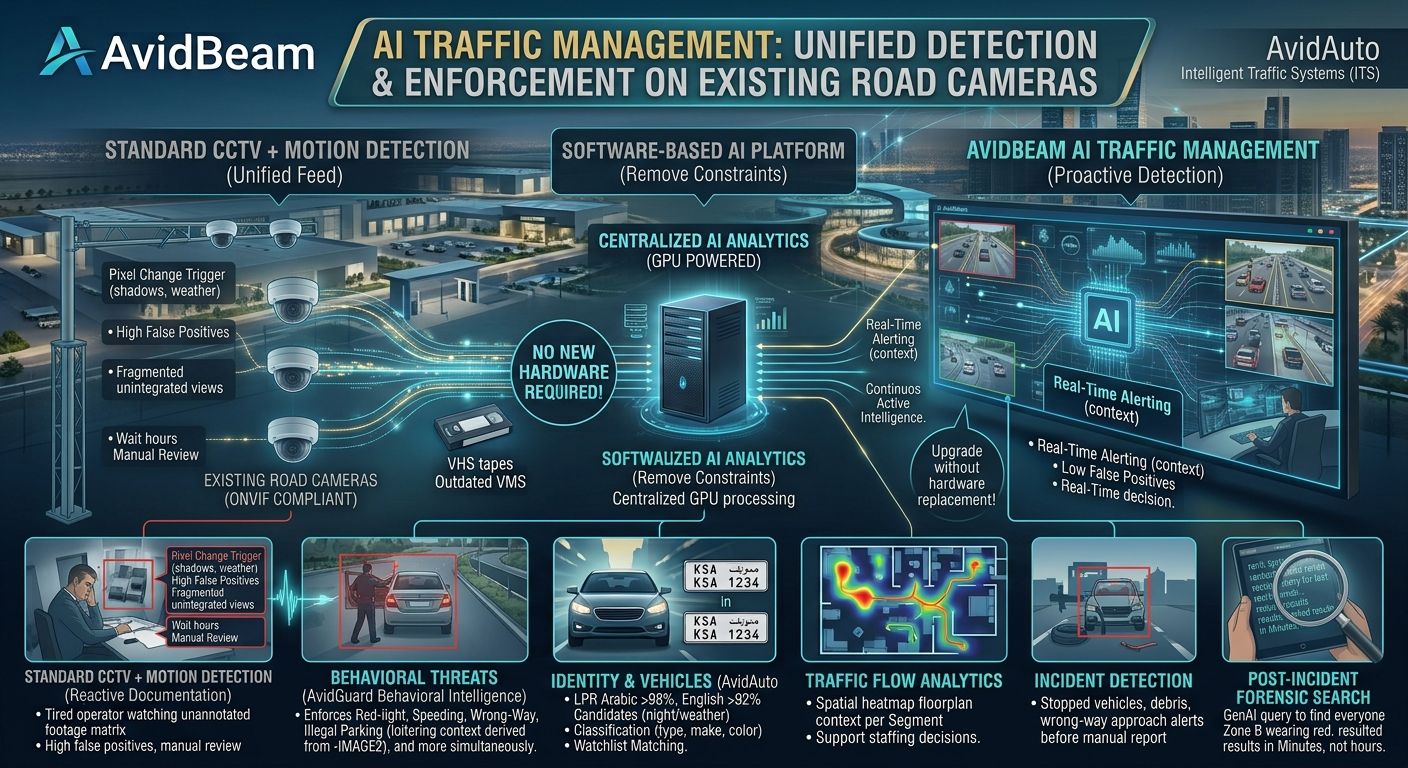
AI Traffic Management: How to Enforce Violations, Monitor Congestion and Forecast Flow Without Adding Officers
AI traffic management is a platform that applies artificial intelligence to road camera feeds to detect violations, monitor traffic density, identify incidents, and produce flow analytics continuously without officers stationed at individual camera points.
 Article
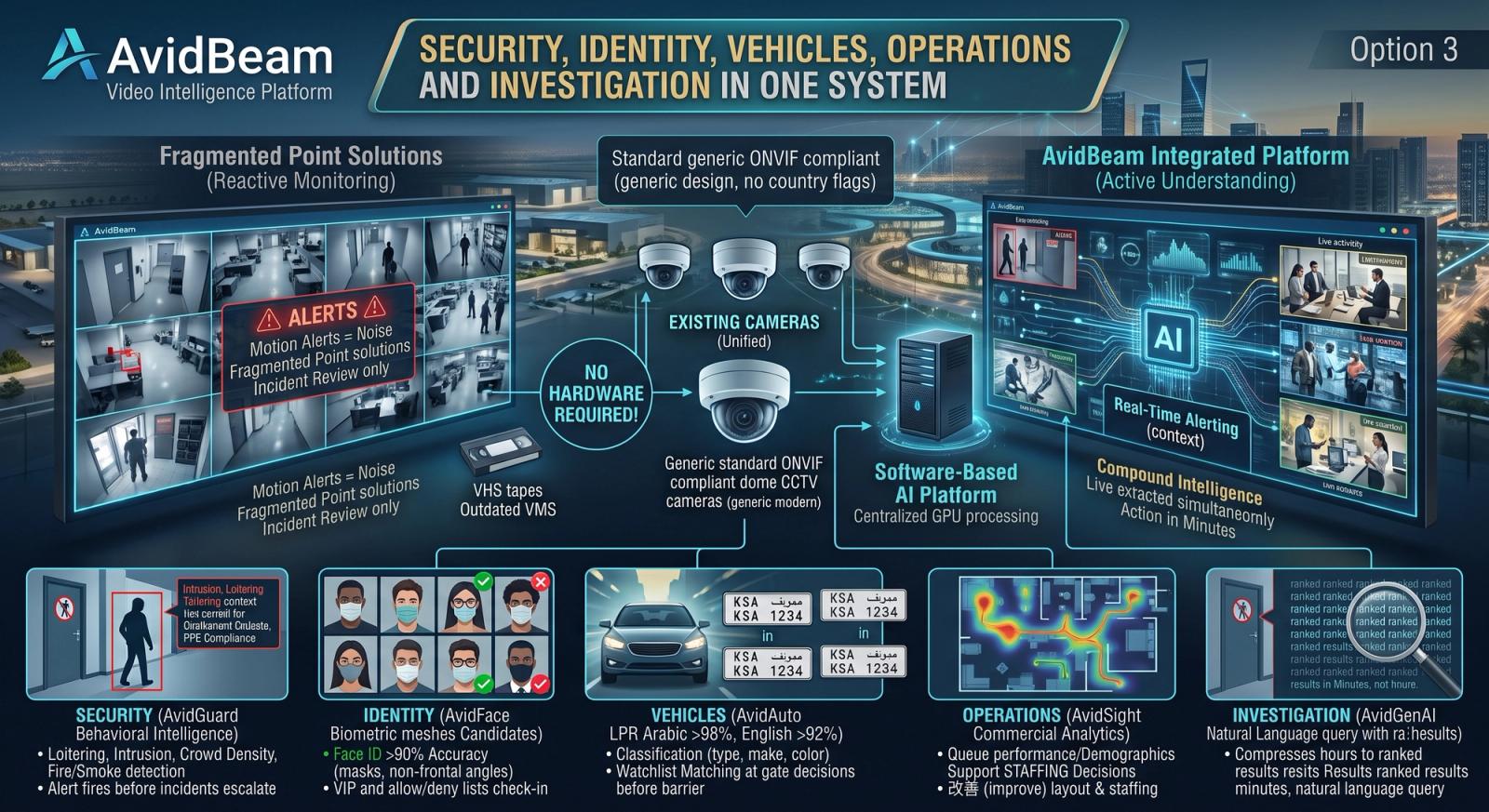
Video Intelligence Platform Explained: Security, Identity, Vehicles, Operations and Investigation in One System
A video intelligence platform is a software system that extracts multiple categories of structured intelligence from camera feeds simultaneously: behavioral security alerts, identity verification
 Article
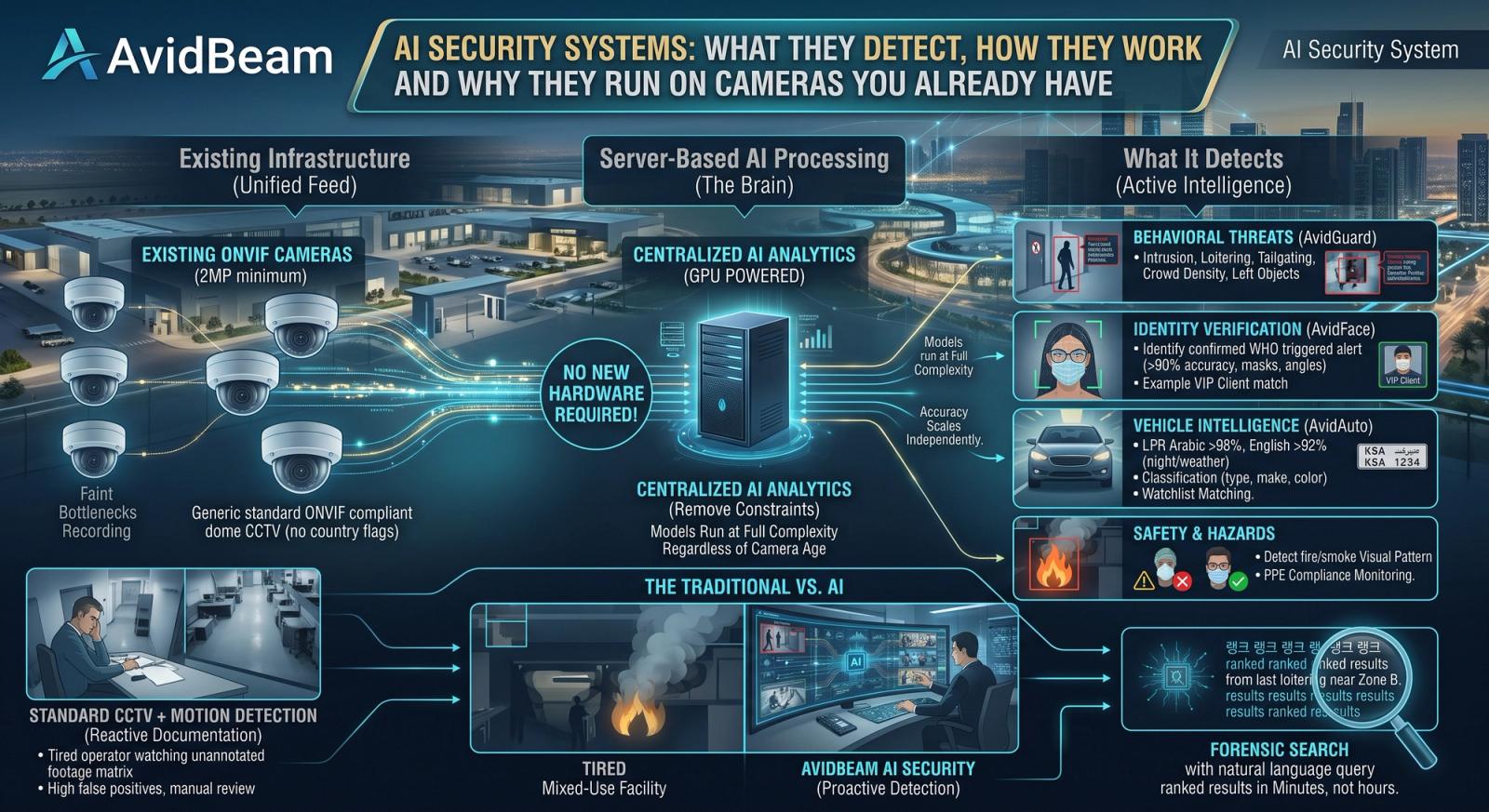
AI Security Systems: What They Detect, How They Work and Why They Run on Cameras You Already Have
An AI security system is a platform that applies artificial intelligence to camera feeds to detect threats, verify identities, and generate security alerts automatically, without requiring a person to monitor screens continuously.
Experience AI Video Analytics
on your existing cameras.
Start with a pilot deployment and scale seamlessly as your operational requirements evolve.