What Intelligent Video Analytics Actually Does That Standard Surveillance Cannot and Why the Architecture Decides the Outcome
Intelligent video analytics is the application of Artificial Intelligence (AI), deep learning, and computer vision to camera feeds to automatically detect security threats, identify individuals, verify compliance, and generate operational intelligence without human review of footage
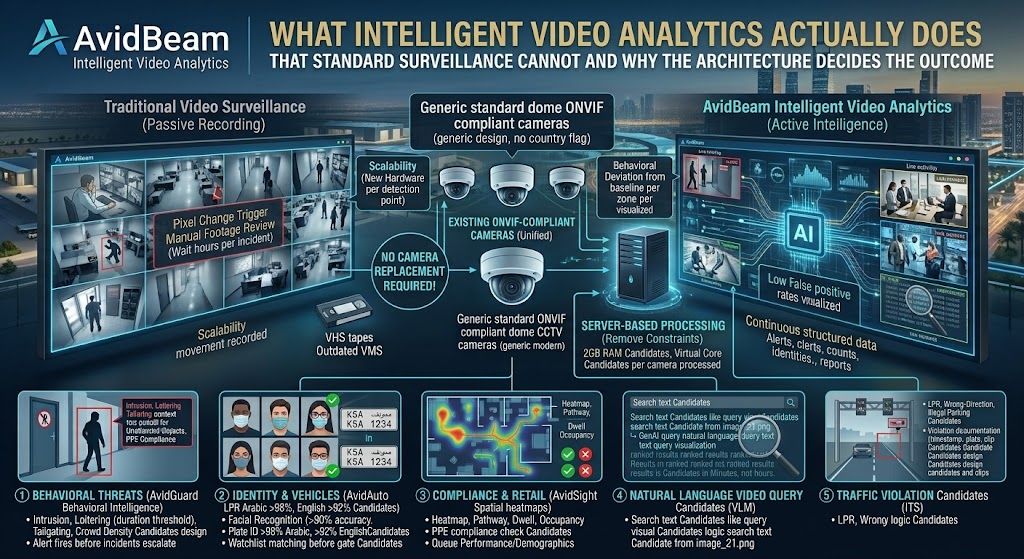
| What is intelligent video analytics?Intelligent video analytics is the application of Artificial Intelligence (AI), deep learning, and computer vision to camera feeds to automatically detect security threats, identify individuals, verify compliance, and generate operational intelligence without human review of footage. Unlike traditional video surveillance, which records footage for retrospective review, intelligent video analytics processes each frame in real time, learning a behavioral baseline per zone and surfacing deviations as structured alerts, reports, and queryable data. It runs on existing camera infrastructure through a central server, requiring no camera replacement. |
Most organizations that ask about intelligent video analytics are already running cameras. The cameras are recording. The footage is being stored. And the incidents, the tailgating at the access point, the loitering near the restricted zone, the PPE violation in the processing area, are being discovered hours or days later during manual review, if they are discovered at all.
Intelligent video analytics changes what those cameras are doing between the recording and the review. Instead of waiting for a human to watch the footage, the analytics platform watches every feed continuously, applies AI models trained on specific threat types and operational patterns, and generates structured outputs in real time: alerts, identity matches, compliance reports, heatmaps, and natural language answers to investigative queries.
The cameras stay. The footage keeps recording. The difference is that the platform is now acting on what the cameras see rather than simply preserving it.
What Is the Difference Between Traditional Surveillance and Intelligent Video Analytics?
The question most organizations face when evaluating intelligent video analytics is not whether it is better than what they have. The question is where the operational gap between their current system and an intelligent platform actually shows up.
The table below maps the specific differences across the dimensions that determine what each system can and cannot do.
| Dimension | Traditional Video Surveillance | Intelligent Video Analytics |
|---|---|---|
| Detection trigger | Motion or pixel change in any zone | Behavioral deviation from a learned per-zone baseline |
| False positive rate | High; weather, animals, and lighting changes trigger alerts | Low; only deviations from the baseline for that specific zone fire |
| Identity awareness | None; records anonymous movement | Named individual tracking via facial recognition across every connected camera |
| Vehicle intelligence | None; records vehicle presence | Plate reading, watchlist cross-reference, and access authorization in real time |
| Post-incident investigation | Manual footage review per camera; hours per incident | Natural language query across full camera network; minutes per incident |
| Scalability | New hardware per additional detection point | Software configuration extends to cameras already on the network |
| Deployment requirement | Camera hardware at each detection point | Server-based processing on existing ONVIF-compliant camera infrastructure |
| Operational output | Footage archive | Alerts, counts, identities, reports, and natural language answers in real time |
As covered in AvidBeam's analysis of the new standard in AI video analytics, the distinction between surveillance infrastructure and an intelligence platform is not a feature difference. It is an architectural difference. Cameras record. Intelligence platforms act.
How Does Intelligent Video Analytics Work?
Understanding how the platform produces intelligence from footage clarifies both what it can detect and why server-based processing outperforms embedded or edge-based alternatives.
The Server-Based Processing Advantage
Intelligent video analytics can run at the camera level, the edge level, or the server level. The architecture choice determines accuracy, scalability, and the range of detection capabilities available.
Camera-embedded and edge-based systems are constrained by the processing capacity of each unit. Detection models run at reduced depth. Accuracy degrades under masks, variable lighting, non-frontal angles, and high-speed movement. Updating detection capabilities requires physical hardware replacement or firmware changes per unit.
Server-based intelligent video analytics processes all camera feeds through dedicated server infrastructure with Graphics Processing Unit (GPU) acceleration. Detection models run at full depth regardless of camera age or specification. Adding detection capabilities means deploying updated models through software across every connected camera at once. The minimum requirement is 2GB RAM and one virtual core at 2.4 GHz per camera processed, with GPU configurations available for higher-density deployments.
How the Platform Learns What Normal Looks Like
The core intelligence mechanism in behavioral detection is per-zone baseline modeling. As covered in AvidBeam's analysis of anomaly detection in video surveillance, rules-based surveillance has a structural problem: it only catches what someone thought to write a rule for. A loitering individual who stays just under a global time threshold does not trigger an alert. An intrusion attempt that looks like ordinary movement does not either.
Intelligent video analytics learns what normal looks like in each specific zone at each specific time of day. An individual who stays near a perimeter boundary for longer than the baseline for that zone and that time window triggers a loitering alert, whether or not their dwell time exceeds a globally configured threshold. The intelligence is specific to the environment, not generically applied across it.
| Want to know which capabilities are available on your existing cameras? Send an email to info@avidbeam.com for a free infrastructure assessment. |
What Can Intelligent Video Analytics Detect and Produce?
The table below maps every capability category in AvidBeam's intelligent video analytics platform, how each one works, and what it produces operationally.
| Capability | How It Works | What It Produces |
|---|---|---|
| Behavioral threat detection | Deep learning models establish a per-zone behavioral baseline; deviations from it generate alerts | Intrusion, loitering, tailgating, crowd density, and left object alerts fire before incidents escalate |
| Facial recognition | Biometric matching against enrolled watchlists at above 90% accuracy across masks, glasses, and angles | Deny-list alerts at access points; VIP recognition; zone movement tracking by named individual |
| License plate recognition | Optical Character Recognition reads Arabic and English plates at 98%+ and 92%+ accuracy respectively | Authorized vehicles cleared automatically; flagged plates trigger alerts before gate clearance |
| PPE compliance verification | Computer vision checks for helmets, vests, gloves, glasses, footwear, and masks at zone entries | Non-compliance alerts fire per zone per individual before they enter the work area |
| Crowd analytics | People counting, density measurement, and demographic estimation from camera feeds | Capacity alerts; peak period data; attendee profiling across events and public spaces |
| Retail and space analytics | Heatmap, dwell time, pathway, and occupancy analytics from existing surveillance cameras | Layout decisions, staffing schedules, and promotional placements based on observed behavior |
| Natural language video query | Vision Language Model converts footage into text; operators query in plain language | Post-incident investigation compressed from hours of footage review to minutes of query response |
| Vehicle and traffic intelligence | LPR, wrong-direction detection, illegal parking, and traffic density from road cameras | Violation documentation with timestamp, plate, and footage; real-time enforcement alerts |
Which Environments Use Intelligent Video Analytics?
Intelligent video analytics applies across environments where security, compliance, and operational decisions depend on understanding what is actually happening inside a monitored space.
Security and Critical Infrastructure
AvidGuard delivers behavioral threat detection, perimeter intrusion monitoring, tailgating detection, and fire and smoke detection across facility zones. The Ministry of Foreign Affairs in Saudi Arabia uses AvidBeam's platform for visitor identification and zone intrusion detection. SABIC uses it for PPE compliance verification across petrochemical facilities.
Access Control and Identity Verification
AvidFace provides facial recognition above 90% accuracy across masks, glasses, and non-frontal angles. It tracks individuals across every connected camera by zone and timestamp, cross-references faces against deny, allow, and Very Important Person (VIP) lists in real time, and compresses post-incident investigation into a reverse image search query rather than manual footage review.
Vehicle and Traffic Management
AvidAuto delivers License Plate Recognition (LPR) at 98%+ accuracy for Arabic plates and 92%+ for English, wrong-direction detection, illegal parking alerts, and smart parking occupancy management. AvidBeam's platform manages a network of 18,000 cameras across Riyadh's smart parking infrastructure from a centralized interface.
Retail, Banking, and Commercial Operations
AvidSight generates heatmap analytics, customer pathway analysis, dwell time measurement, queue monitoring, and demographic profiling from existing store and branch cameras. It also covers banking-specific detection: Automated Teller Machine (ATM) violation detection, vault access policy enforcement, and employee presence monitoring.
Events and Mass-Attendance Environments
AvidBeam deployed intelligent video analytics across Soundstorm 2024 and 2025 in Riyadh, managing crowd density monitoring, facial recognition, demographics detection, and people counting across an event attended by more than 450,000 fans over three days per edition. The same platform covered BaladBeast in Jeddah and Qiddiya's entertainment destination.
What Does Intelligent Video Analytics Require to Deploy?
AvidBeam's platform connects to any Open Network Video Interface Forum (ONVIF) compliant camera with a minimum 2 Megapixel resolution. No camera replacement is required. All processing runs on a central server connected to the existing camera network through standard network protocols.
The platform integrates with existing Video Management System (VMS) platforms including Milestone, NetworkOptix, and Genetec. Deployment options include on-premise, private cloud, public cloud, and hybrid configurations. On-premise deployment keeps all data and processing local, the configuration required for government facilities and high-security environments. AvidGenAI's Vision Language Model layer adds natural language querying across the full camera network, enabling operators to ask questions in plain language and receive answers with timestamps and camera sources rather than pulling multiple reports manually.
FAQ
What is intelligent video analytics?
The application of AI, deep learning, and computer vision to camera feeds to automatically detect threats, identify individuals, verify compliance, and generate operational intelligence from existing cameras in real time without requiring human review of footage.
How is intelligent video analytics different from standard CCTV?
Standard CCTV records footage for retrospective review; intelligent video analytics processes footage continuously in real time, generating alerts, identity matches, compliance reports, and operational data as events occur rather than after they have been discovered.
Does intelligent video analytics require new cameras?
No. AvidBeam's platform connects to any existing ONVIF compliant camera with 2MP minimum resolution; all AI processing runs on a central server, not inside individual cameras, requiring no hardware replacement.
How accurate is intelligent video analytics for facial recognition?
AvidFace sustains above 90% accuracy for facial recognition under masks, glasses, hats, and non-frontal angles through centralized server-based processing regardless of individual camera hardware specification.
Which environments benefit most from intelligent video analytics?
Security and critical infrastructure, access control facilities, retail and banking environments, vehicle and traffic management, events and mass-attendance venues, and any environment where understanding what is happening inside a monitored space improves security, compliance, or operational decisions.
Can intelligent video analytics run on a large camera network?
Yes. AvidBeam's platform manages networks at scale, including 18,000 cameras across Riyadh's smart parking infrastructure, from a centralized server interface without per-camera configuration.
What is the difference between edge-based and server-based intelligent video analytics?
Edge-based systems are constrained by each camera's local processing capacity, which degrades accuracy under challenging conditions; server-based platforms run full-depth AI models centrally across all cameras simultaneously, sustaining consistent accuracy regardless of camera age or specification.
| Want to see intelligent video analytics in action?Request a live demo of AvidBeam's platform on your existing cameras. Send an email to info@avidbeam.com to schedule a session with the technical team. |
 Article
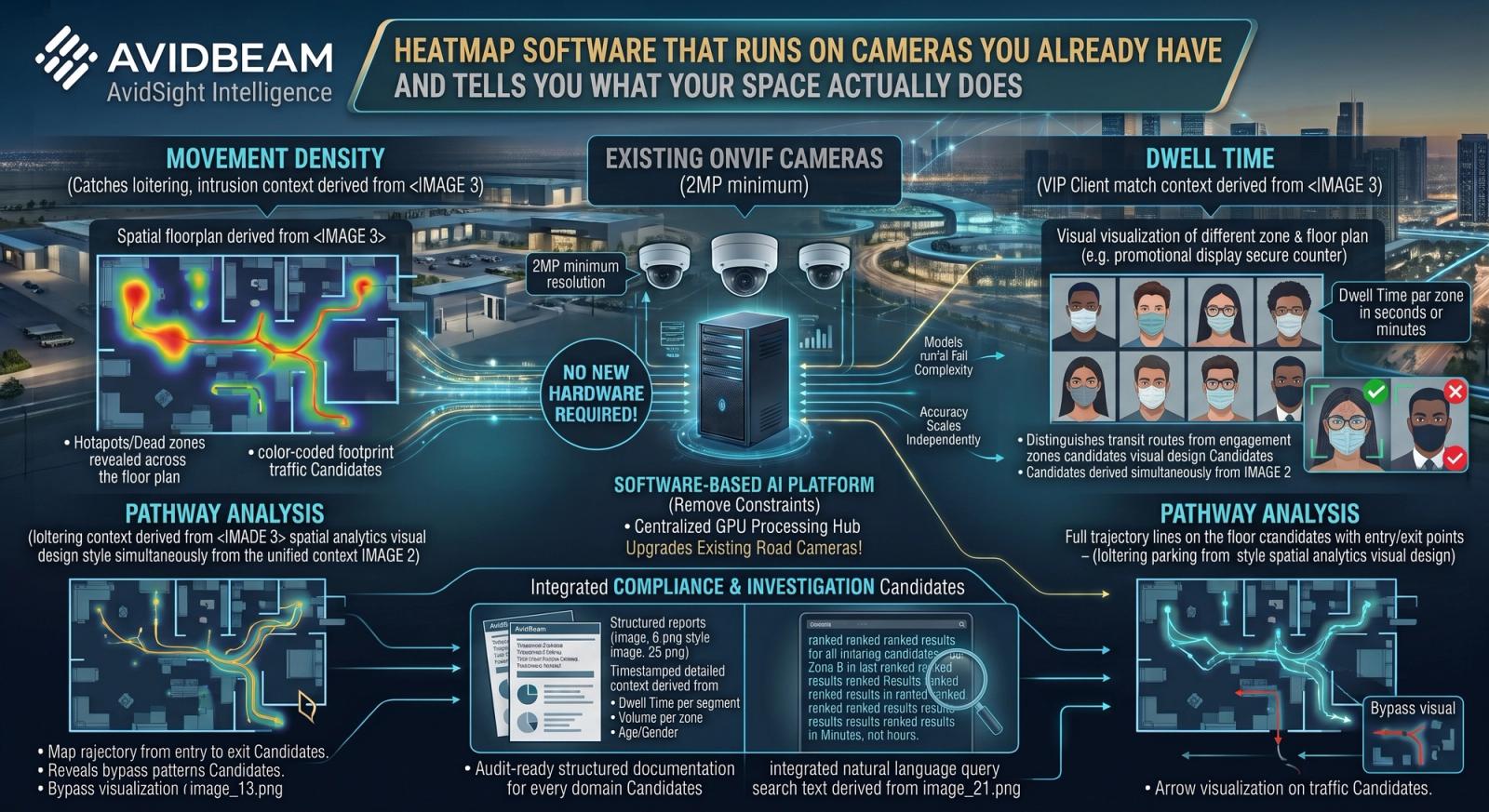
Heatmap Software That Runs on Cameras You Already Have and Tells You What Your Space Actually Does
If you are evaluating heatmap software, you probably already know that something about your space is not working the way you expected. Customers are not finding a product zone. A service counter has inconsistent wait times
 Article
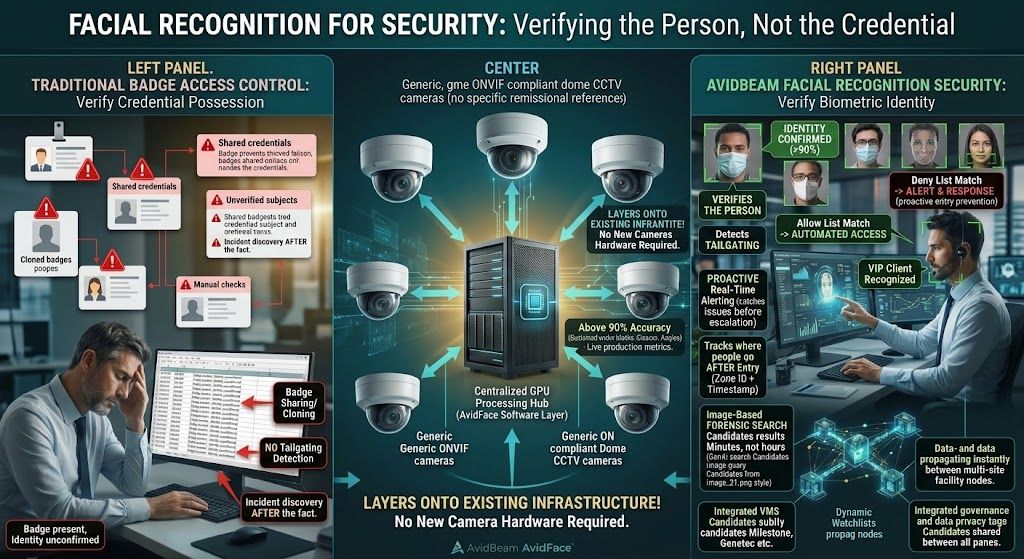
Facial Recognition for Security: What It Catches That Badge Systems Cannot and How It Works on Existing Cameras
Badge-based access control has one fundamental limitation: it verifies that a credential is present, not that the person presenting it is who it says they are. A badge can be cloned, shared, lost, or used by someone it was not issued to
 Article
What Video Analytics Does for Hotels and Resorts Beyond Recording and Why It Matters for Guest Experience
Video analytics for hospitality is the application of AI to hotel and resort camera feeds to improve guest experience, enhance security, and generate operational intelligence simultaneously
Experience AI Video Analytics
on your existing cameras.
Start with a pilot deployment and scale seamlessly as your operational requirements evolve.