AI Vision System: What It Detects and How It Works | Avidbeam
Standard cameras record. An AI vision system interprets. That distinction drives the entire shift from passive surveillance to active intelligence, and it explains why organizations across security, retail and transportation
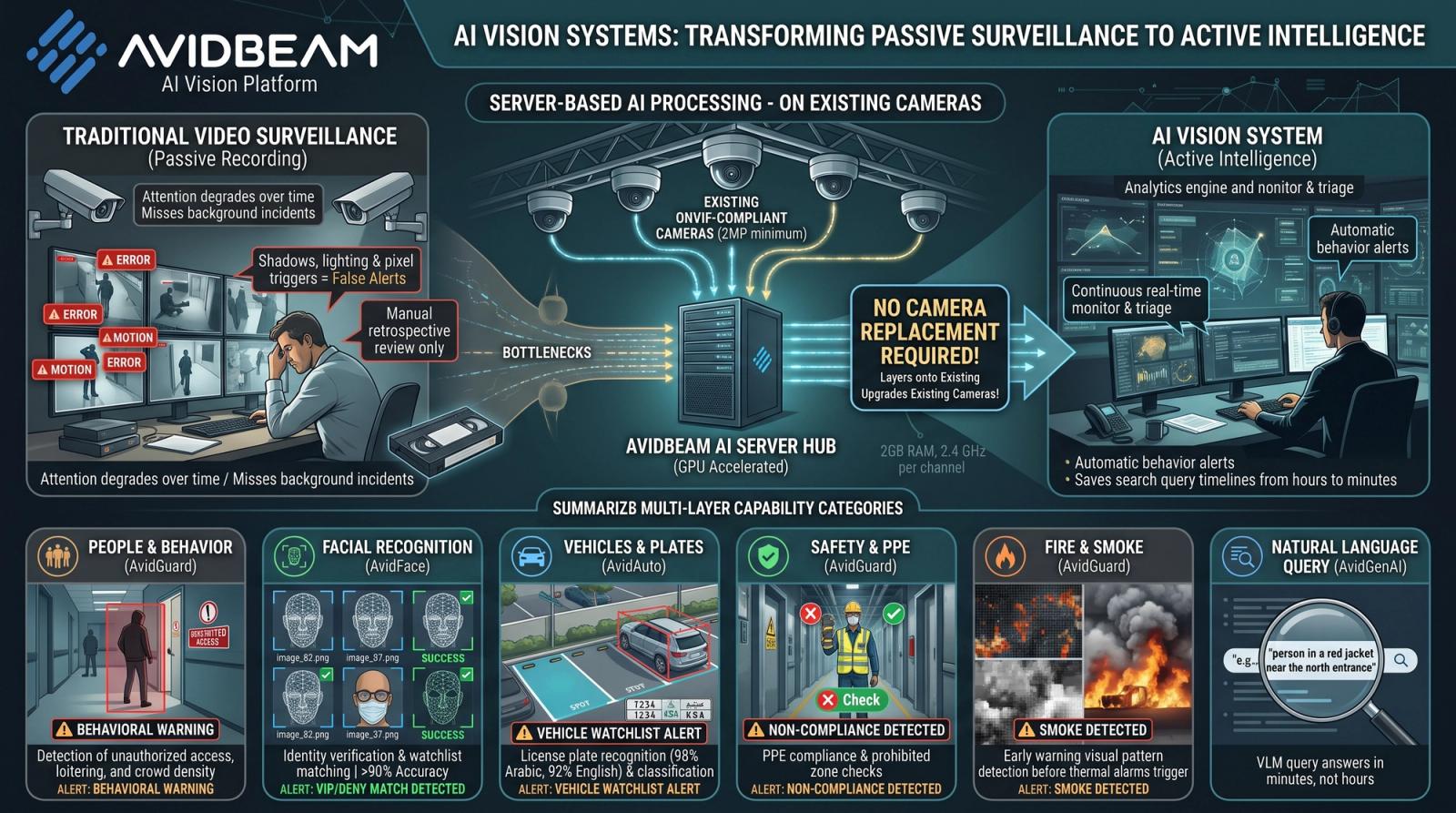
| What Is an AI Vision System?An AI vision system is a software-based platform that uses computer vision and machine learning to analyze live camera feeds in real time. It detects people, vehicles, behaviors, and safety conditions, then converts those detections into alerts, reports, and operational intelligence. Unlike standard surveillance, an AI vision system does not just record: it understands what it sees and acts on it. |
Standard cameras record. An AI vision system interprets. That distinction drives the entire shift from passive surveillance to active intelligence, and it explains why organizations across security, retail, transportation, and industrial operations are replacing conventional setups with AI-driven video platforms.
This article explains what an AI vision system is, what it detects, how it is deployed, and why a server-based architecture produces better results than edge-based or cloud-only alternatives.
What Is an AI Vision System?
An AI vision system applies computer vision algorithms to live video feeds to detect, classify, and respond to events in real time. The system processes raw pixel data from cameras and uses trained models to recognize specific objects, behaviors, and conditions: a person entering a restricted zone, a vehicle without a valid plate, a worker without a safety helmet, or smoke appearing in an industrial area.
Most AI vision systems run as software on dedicated servers, which separates the intelligence layer from the camera hardware. This matters because it allows organizations to upgrade their detection capabilities without replacing cameras, and it allows multiple detection types to run simultaneously on the same feed.
How It Differs from Standard Surveillance
Standard surveillance systems record continuously and rely on a human operator to watch the footage, spot an incident, and respond. This approach has a well-documented problem: attention degrades over time, and operators miss incidents that happen in the background or across multiple screens simultaneously.
An AI vision system removes the dependency on constant human attention. The software monitors every camera feed continuously, applies detection models to the video, and sends an alert when a defined condition is met. Operators respond to confirmed events rather than watching for them.
The result is faster response times, fewer missed incidents, and a shift of human attention toward decision-making rather than observation.
Core Components of an AI Vision System
Every AI vision system includes four core components. The first is an ingestion layer that pulls video streams from connected cameras using standard protocols such as ONVIF (Open Network Video Interface Forum) or RTSP (Real Time Streaming Protocol). The second is an analytics engine that runs detection models against the video in real time. The third is an alerting and notification layer that sends event-triggered alerts to operators via dashboard, email, or integration with a video management system (VMS). The fourth is a reporting layer that stores event logs, produces compliance reports, and supports audit workflows.
In a server-based architecture, all four components run on a central server rather than on the camera itself. This gives the system access to greater processing power, allows it to run multiple simultaneous detection models, and simplifies maintenance and updates.
What an AI Vision System Detects
The detection capability of an AI vision system depends on the models loaded into its analytics engine. Modern platforms support a wide range of detection categories, often running several simultaneously on the same feed. The table below covers the categories relevant to security, safety, and operations.
| Detection Category | What It Detects | Operational Value |
| People and Behavior | Unauthorized access, loitering, crowd density, queue length | Security alerts, staff deployment, service optimization |
| Facial Recognition | Identity verification, watchlist matching, VIP identification | Access control, fraud prevention, personalized service |
| Vehicles and Plates | License plate reading, vehicle classification, speed and direction | Access control, traffic enforcement, logistics tracking |
| Safety and PPE | Missing helmets, vests, gloves, masks; prohibited zone entry | Workplace compliance, incident prevention, audit trails |
| Fire and Smoke | Smoke appearance, flame spread, heat buildup in frame | Early fire detection before traditional alarms trigger |
| Anomalies | Abandoned objects, aggressive behavior, perimeter breach | Threat identification, proactive intervention |
| Retail Intelligence | Dwell time, customer flow, conversion zone behavior | Store layout optimization, staff scheduling, revenue insight |
| Traffic Flow | Vehicle count, lane usage, violation detection | Road enforcement, congestion management, urban planning |
People and Behavioral Events
People detection is the most common application. An AI vision system can track the number of people in a frame, detect when a person enters a defined zone, identify loitering behavior, measure queue length, and alert on crowd density thresholds. These detections apply across security, retail, and public venue management.
Behavioral detection goes further. The system can identify aggressive movement patterns, detect an object left unattended in a sensitive area, or flag unusual movement direction. These are the events most likely to precede a security incident, and they are also the ones most likely to be missed by a human operator watching multiple screens.
Vehicles and License Plates
Vehicle detection covers classification by type, direction of travel, speed estimation, and license plate recognition (LPR). LPR systems read plate numbers, match them against approved or flagged lists, and trigger access control decisions in real time. AvidBeam's AvidAuto platform achieves over 98% accuracy on Arabic plates and over 92% on English plates.
Vehicle analytics also support parking management, port logistics, and traffic enforcement. A single camera with an AI vision system can replace multiple manual checkpoints.
Safety and Compliance Violations
Personal protective equipment (PPE) detection is one of the fastest-growing applications of AI vision in industrial environments. The system identifies workers missing helmets, high-visibility vests, gloves, or masks, and sends an alert or a barrier signal before an incident occurs. This is a fundamentally different approach from traditional PPE compliance, which depends on supervisors conducting manual checks.
Fire and smoke detection through video analytics works by analyzing pixel changes that match the appearance of smoke or flame. This approach detects fire earlier than conventional heat or ionization sensors, because it responds to visual evidence before temperature thresholds are reached.
How AvidBeam Deploys AI Vision Systems
AvidBeam's AI vision platform is server-based, which means the detection engine runs on a central server rather than on the camera or in the cloud. This architecture is the foundation of AvidBeam's approach to scalable, accurate video analytics, and it determines how the system performs across all deployment environments.
Server-Based Architecture
In a server-based deployment, cameras stream video to a dedicated analytics server. The server runs AvidBeam's detection models against the streams and outputs alerts, events, and reports to an operator dashboard or an integrated VMS. Each server handles multiple camera streams simultaneously, and detection models can be updated centrally without touching individual cameras.
The server requires a minimum of 2 GB of RAM and a 2.4 GHz processor per camera channel. This ensures that each stream receives full processing capacity rather than sharing resources with other channels. The result is consistent detection accuracy regardless of how many cameras are connected to the system.
Server-based architecture also enables AvidBeam's integration with leading VMS platforms, including Milestone, NetworkOptix, and Genetec. For a deeper look at what this means for enterprise security, see AI Security Systems: What They Detect and How They Work.
Integration with Existing Cameras
One of the most common concerns among organizations evaluating AI vision systems is whether they need to replace their cameras. AvidBeam's server-based platform works with any ONVIF-compliant camera, which covers the vast majority of cameras installed in enterprise environments today.
This means organizations can deploy AI vision without a hardware refresh. The intelligence layer is added in software, and the existing camera infrastructure continues to operate unchanged. Deployment timelines are shorter, capital costs are lower, and the organization retains flexibility to upgrade cameras on their own schedule.
For organizations looking at the broader picture of what server-based platforms enable, Server-Based Video Analytics covers the architecture in detail.
AvidGenAI: Natural Language Video Investigation
AvidBeam's AvidGenAI module adds a generative AI layer on top of the video analytics platform. Operators can search recorded footage using plain language queries rather than manual review. A query such as 'show me every instance of a person in a red jacket near the north entrance returns relevant clips without frame-by-frame scrubbing.
This capability transforms post-incident investigation. What previously required hours of manual review can be completed in minutes, and the results are more reliable because the search is exhaustive rather than dependent on an operator's attention and recall.
Deployment Environments for AI Vision Systems
AI vision systems are deployed across a wide range of industries and operational contexts. The table below maps the most common environments to their primary use cases, the AvidBeam module that applies, and the camera requirements.
| Environment | Primary Use Case | AvidBeam Module | Camera Requirement |
| Government and Defense | Perimeter security, identity verification, threat detection | AvidGuard | Existing ONVIF cameras |
| Banking | Fraud detection, ATM monitoring, customer flow | AvidFace, AvidGuard | Existing cameras |
| Retail | Shopper behavior, dwell time, queue analytics | AvidSight | Existing cameras |
| Industrial and Oil and Gas | PPE compliance, zone access, fire and smoke detection | AvidGuard | Existing cameras |
| Transportation | License plate recognition, traffic violation detection | AvidAuto | Fixed or PTZ cameras |
| Hospitality | Guest analytics, occupancy, VIP recognition | AvidSight, AvidFace | Existing cameras |
| Smart Cities | Crowd management, anomaly detection, traffic flow | AvidGuard, AvidAuto | Any ONVIF-compliant |
| Ports and Logistics | Container tracking, vehicle access, perimeter monitoring | AvidAuto, AvidGuard | Existing cameras |
What to Consider Before Deploying an AI Vision System
Several factors determine whether an AI vision system will deliver the results an organization expects. Understanding them before deployment avoids the most common failure points.
Camera Placement and Coverage
The accuracy of an AI vision system depends on the quality and placement of the cameras feeding it. Cameras positioned too far from a target, angled poorly, or obstructed by environmental conditions such as glare or physical barriers will produce lower-quality input and reduce detection accuracy. Camera placement should be assessed as part of the deployment design, not after the system is installed.
Detection Model Selection
Not all detection models apply to all environments. A retail deployment prioritizes people counting and dwell time. An industrial site prioritizes PPE compliance and fire detection. A transportation hub prioritizes license plate recognition and vehicle flow. Selecting the right models for each camera location ensures the system is configured to detect the events that actually matter to the organization.
Integration with Existing Systems
An AI vision system delivers more value when its outputs connect to other operational systems. Alerts that feed into an existing security operations center (SOC) workflow reach the right people faster. Events that are logged alongside access control data produce richer audit trails. Integration planning should happen before deployment, not after.
Frequently Asked Questions
What is the difference between an AI vision system and a standard CCTV system?
A CCTV system records video passively; an AI vision system analyzes video in real time and sends alerts when defined conditions are detected.
Do I need to replace my cameras to deploy an AI vision system?
No. AvidBeam's server-based platform works with any ONVIF-compliant camera already installed in your environment.
How accurate is AI vision detection?
Accuracy depends on detection type: AvidFace achieves over 90% facial recognition accuracy and AvidAuto achieves over 98% on Arabic plates and over 92% on English plates under standard conditions.
Can an AI vision system run multiple detection models at the same time?
Yes. AvidBeam's server-based platform runs multiple detection models simultaneously on the same camera feed without degrading accuracy.
What VMS platforms does AvidBeam integrate with?
AvidBeam integrates with Milestone, NetworkOptix, and Genetec, covering the majority of enterprise VMS deployments.
Is the system suitable for outdoor environments?
Yes. AvidBeam's platform supports outdoor deployments including perimeter security, traffic monitoring, and port operations, provided cameras meet minimum specifications.
How does AvidBeam's AI vision system handle low-light conditions?
The platform works with the video input it receives; low-light performance depends on the camera. Infrared or thermal cameras can be paired with the platform for 24-hour detection in low-light environments.
What hardware does the server require?
AvidBeam's server requires a minimum of 2 GB of RAM and a 2.4 GHz processor per camera channel, running on standard server hardware with GPU support for high-volume deployments.
AvidBeam's AI vision platform runs on all NVIDIA GPU families and is deployed by AvidGuard, AvidBeam's core security and surveillance module, across government, industrial, and enterprise environments.
| See an AI Vision System in ActionAvidBeam deploys server-based AI vision across security, safety, and operations. Request a live demo tailored to your environment.Request a Demo at avidbeam.com/contact |
 Article
Face Registration: Plan a Practical Event Check-In Workflow - Avidbeam
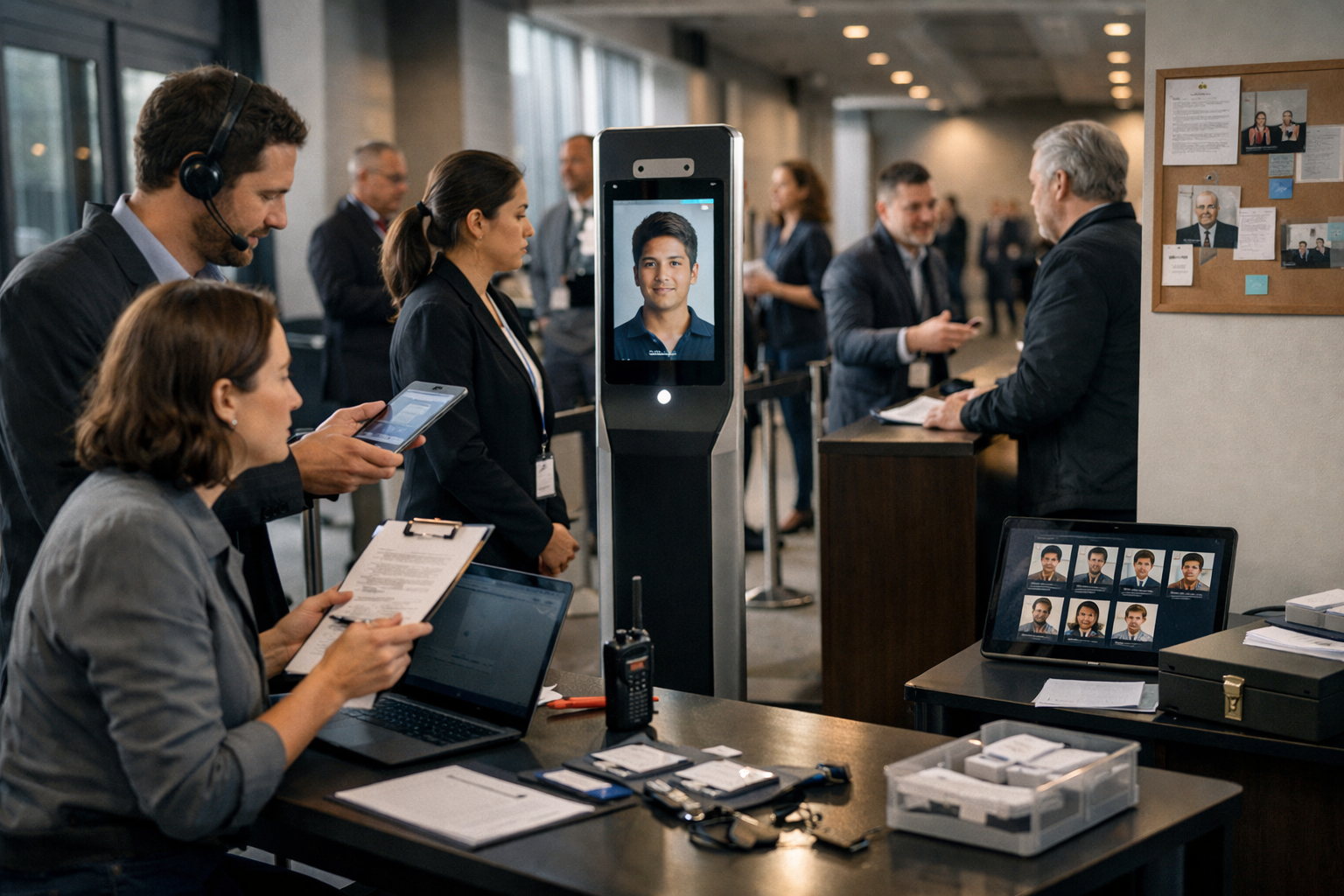
Face registration is biometric enrollment: collecting facial information to create a reference for later comparison. For event organizers, the challenge is fitting that step into ticketing, attendee communications, and arrival-day operations without leaving staff or participants unsure what happens next.
 Article
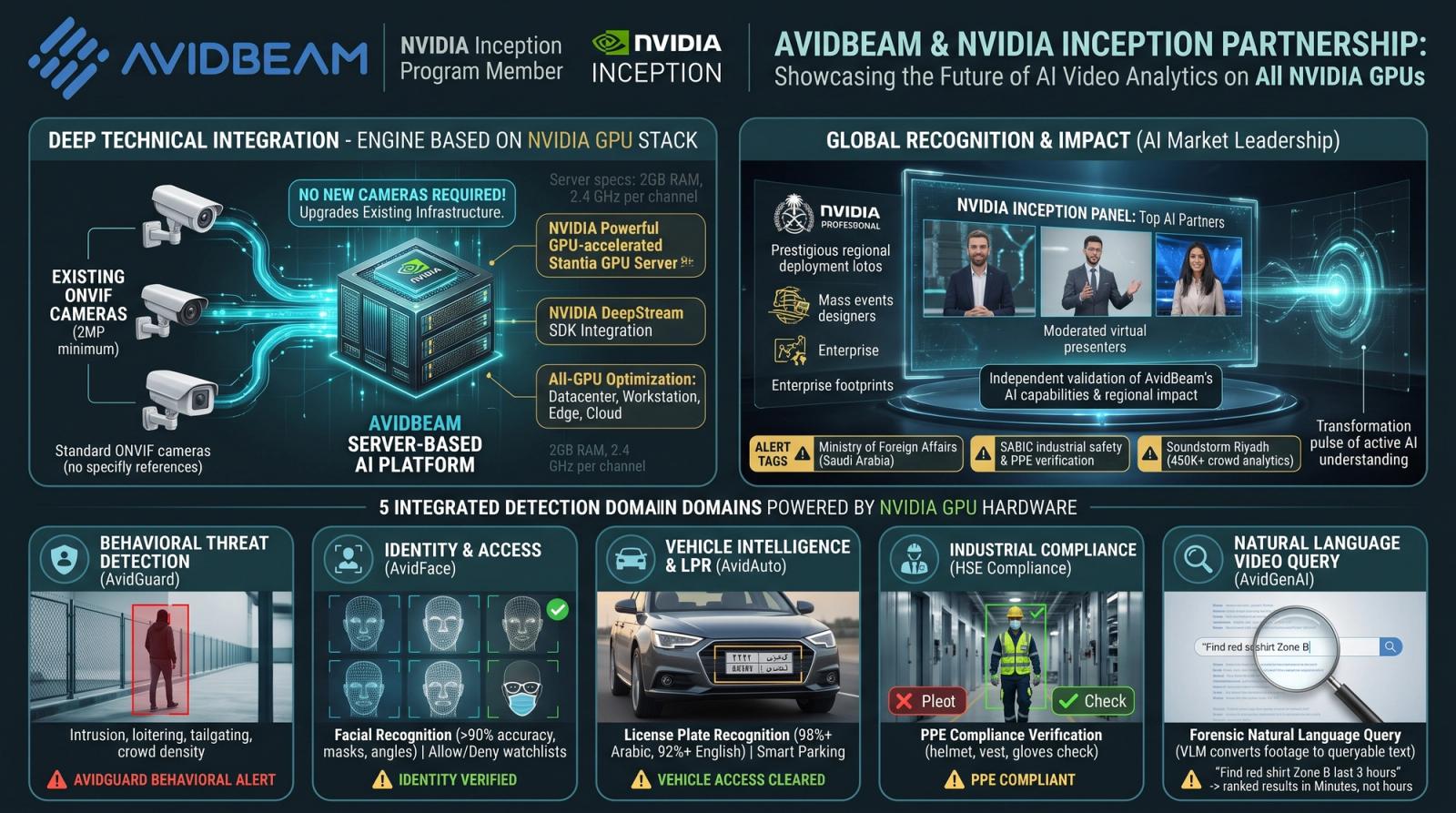
AvidBeam and NVIDIA: An Inception Partnership Built on Full GPU Compatibility and Regional Leadership
The NVIDIA Inception program is a global initiative that supports and recognizes AI companies building products and services on NVIDIA technology.
 Article
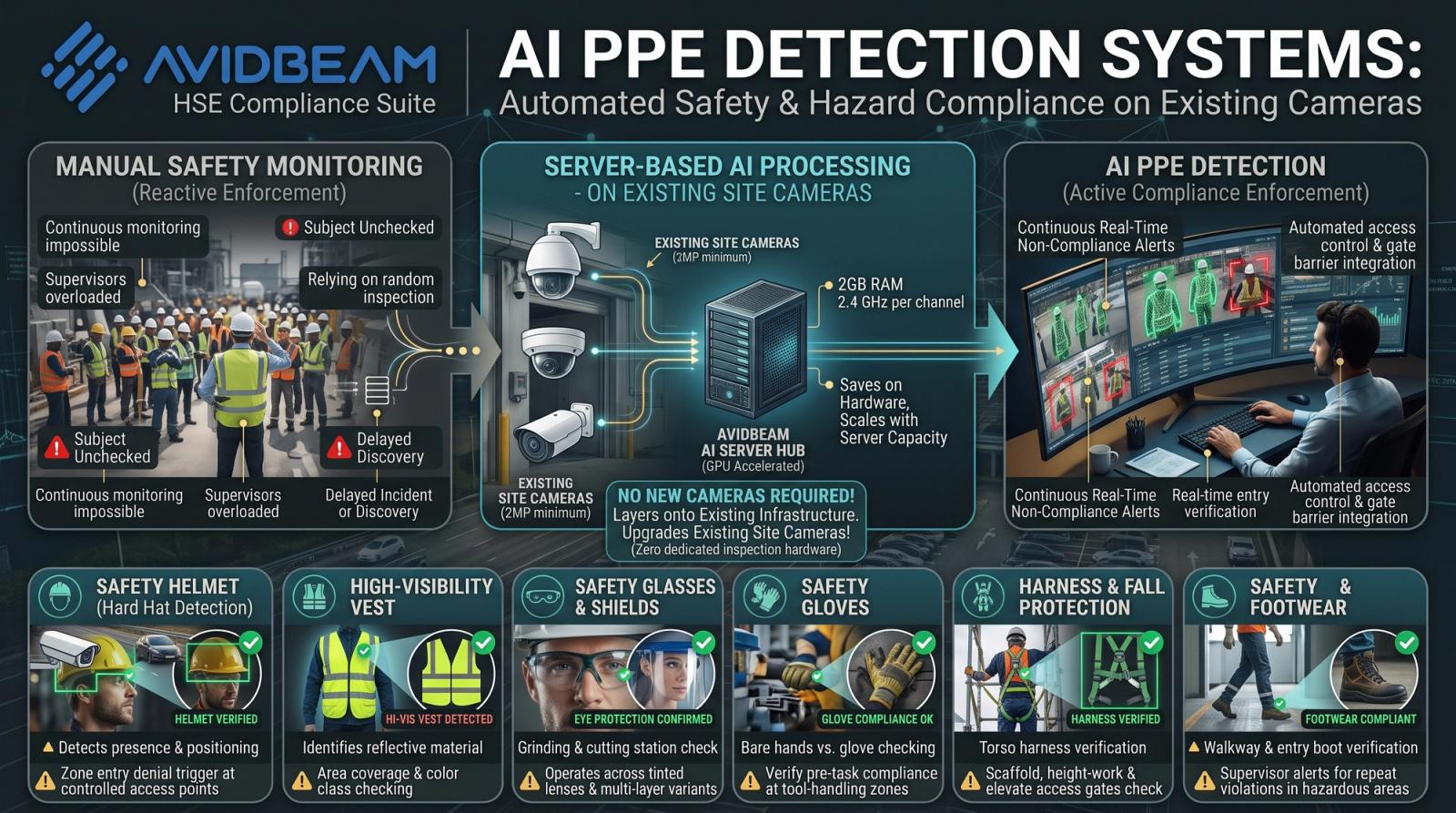
How AI PPE Detection Verifies Every Worker Before Zone Entry Without Manual Checks
PPE detection (Personal Protective Equipment) is the use of artificial intelligence (AI)-powered computer vision to automatically verify that workers are wearing the required personal protective equipment (PPE) before entering.
Experience AI Video Analytics
on your existing cameras.
Start with a pilot deployment and scale seamlessly as your operational requirements evolve.